The Origins of El Cucuy
El Cucuy (also known as El Coco, Cuco,
or Cucuy) is a shadowy figure from Spanish and Latin American folklore,
often described as a monstrous boogeyman who punishes disobedient children. The legend has
been passed down for generations and was traditionally used by parents as a fear-based
disciplinary tool. Children are warned that if they misbehave, El Cucuy will come in the
night to snatch them away. The fear of El Cucuy is deeply rooted in childhood, creating a
lasting psychological impact. Unlike other mythical monsters, El Cucuy has no fixed appearance,
this shapelessness makes him even more terrifying, as the imagination fills in the blanks.
Different Names, Same Nightmare
The name and concept of El Cucuy varies significantly from country to country, demonstrating
the cultural variety within the folklore of Spanish and Portuguese speaking communities. In
Spain and much of Latin America, he's known as "El Coco," a shadowy boogeyman figure
who hides in closets or under beds, waiting to snatch misbehaving children. In places like
Puerto Rico, the Dominican Republic, and parts of Central and South America, variations like
"El Cuco" or "El Cucuy" are common, often described as a shapeshifter or
faceless creature that stalks the night.
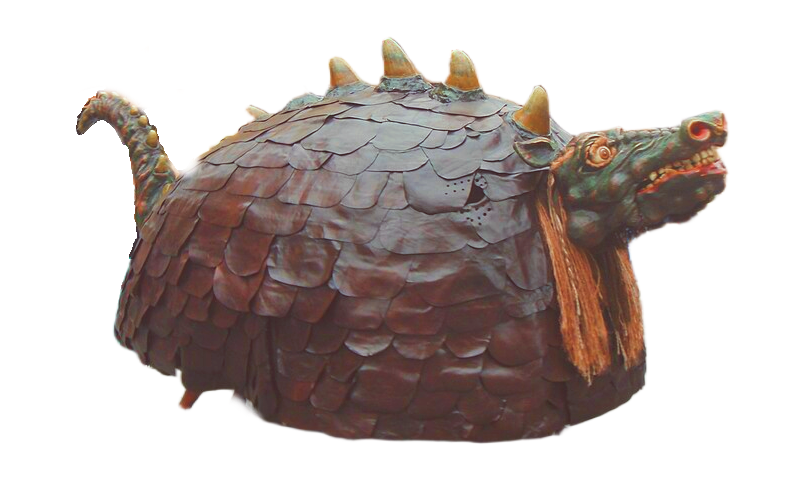
In Portugal, the legend takes on a slightly different form in "La Coca" or "
Cucafera," mythical dragon-like beasts that appear during Corpus Christi festivals,
symbolizing the triumph of good over evil. These creatures are part of public parades and
are often used to teach moral lessons through spectacle. In Brazil, the fearsome
"Cuca" is portrayed as a terrifying old witch or a crocodile headed woman who
haunts children who don’t sleep on time. She was popularized further in Brazilian culture
by Monteiro Lobato's children's books, where she became a staple nightmare figure.
Despite regional differences in appearance, name, and even behavior, these creatures serve a
common purpose: enforcing discipline through fear. Whether he's a shapeless shadow, a scaly
dragon, or a reptilian witch, the Cucuy character is a manifestation of parental authority,
cultural fears, and moral teaching. The universality of this legend highlights how societies
often use myth to communicate values and boundaries to younger generations, blending folklore
with everyday parenting.
A Muse of Shadows
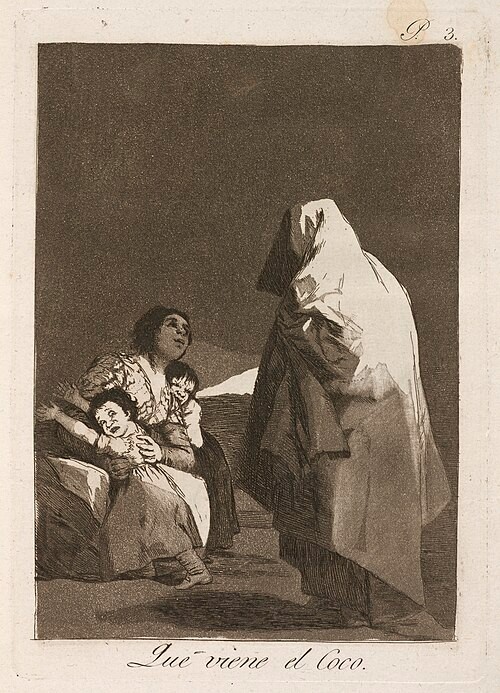
The Cucuy has made a lasting impact on visual and literary culture. Francisco de Goya’s painting
Que viene el Coco ("Here Comes the Bogeyman") from 1799 is one of the most famous artistic
depictions. It shows a shadowy figure cloaked in black, leaning into a frightened mother and child,
perfectly capturing the theme of fear as a form of control. In literature, references to the Cucuy
date back to 15th-century Spanish poetry. Poets like Federico García Lorca wrote about the Cucuy as
a metaphor for the unknown and for childhood fears. The legend has remained relevant in modern times
as well, appearing in books, TV shows, and even video games, adapting to new media while retaining
its eerie power.