
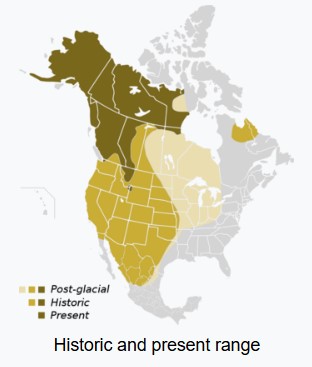
Grizzly bears can be found in woodlands, forests, alpine meadows, and prairies. In many habitats they prefer riparian areas along rivers and streams. In North America, grizzly bears previously roamed throughout the entire United States from Alaska south into Mexico, from California to the western shores of the Hudson Bay. Control actions and habitat loss extirpated them from 98 percent of their original habitat in the U.S., including the Great Plains and all habitats south of Yellowstone National Park and Grand Teton National Park in Wyoming. This also included most of California, Oregon, Washington and Idaho. Populations persisted in the Northern Rocky Mountains including in Yellowstone and Glacier National Parks and in northwestern Montana and extreme northern Idaho next to Canada. A large population of grizzly bears lives inland in Alaska and northern Canada. Thanks to conservation efforts since about 1975, grizzly bears are recovering well in Yellowstone and elsewhere in the Northern Rockies and are even beginning to recolonize prairie habitats along the Rocky Mountain Front in Montana. There have also been discussions recently about reintroducing grizzly bears back into remote parts of states such as California.
In Canada, there are approximately 25,000 grizzly bears occupying British Columbia, Alberta, the Yukon, the Northwest Territories, Nunavut, and the northern part of Manitoba. An article published in 1954 suggested they may be present in the tundra areas of the Ungava Peninsula and the northern tip of Labrador-Quebec. In British Columbia, grizzly bears inhabit approximately 90% of their original territory. There were approximately 25,000 grizzly bears in British Columbia when the European settlers arrived. However, population size has since significantly decreased due to hunting and habitat loss. In 2008, it was estimated there were 16,000 grizzly bears. A revised Grizzly bear count in 2012 for British Columbia was 15,075. Population estimates for British Columbia are based on hair-snagging, DNA-based inventories, mark-and-recapture, and a refined multiple regression model. In 2003, researchers from the University of Alberta spotted a grizzly on Melville Island in the high Arctic, which is the most northerly sighting ever documented.
Conservation efforts have become an increasingly vital investment over recent decades, as population numbers have dramatically declined. Establishment of parks and protected areas are one of the main focuses currently being tackled to help reestablish the low grizzly bear population in British Columbia. One example of these efforts is the Khutzeymateen Grizzly Bear Sanctuary located along the north coast of British Columbia; at 44,300 ha (109,000 acres) in size, it is composed of key habitat for this threatened species. Regulations such as limited public access, as well as a strict no hunting policy, have enabled this location to be a safe haven for local grizzlies in the area. When choosing the location of a park focused on grizzly bear conservation, factors such as habitat quality and connectivity to other habitat patches are considered. The Refuge for Endangered Wildlife located on Grouse Mountain in Vancouver is an example of a different type of conservation effort for the diminishing grizzly bear population. The refuge is a five-acre terrain which has functioned as a home for two orphaned grizzly bears since 2001. The purpose of this refuge is to provide awareness and education to the public about grizzly bears, as well as providing an area for research and observation of this secluded species. Another factor currently being taken into consideration when designing conservation plans for future generations are anthropogenic barriers in the form of urban development and roads. These elements are acting as obstacles, causing fragmentation of the remaining grizzly bear population habitat and prevention of gene flow between subpopulations (for example, Banff National Park). This, in turn, is creating a decline in genetic diversity, and therefore the overall fitness of the general population is lowered. In light of these issues, conservation plans often include migration corridors by way of long strips of "park forest" to connect less developed areas, or by way of tunnels and overpasses over busy roads. Using GPS collar tracking, scientists can study whether or not these efforts are actually making a positive contribution towards resolving the problem. To date, most corridors are found to be infrequently used, and thus genetic isolation is currently occurring, which can result in inbreeding and therefore an increased frequency of deleterious genes through genetic drift. Current data suggest female grizzly bears are disproportionately less likely than males to use these corridors, which can prevent mate access and decrease the number of offspring.
In the United States, national efforts have been made since 1982 for the recovery plan of grizzly bears. The Interagency Grizzly Bear Recovery Committee is one of many organizations committed to the recovery of grizzly bears in the lower 48 states. There are five recovery zones for grizzly bears in the lower 48 states including the North Cascades ecosystem in Washington state. The National Park Service and U.S. Fish and Wildlife initiated the process of an environmental impact statement in the fall of 2014 to begin the recovery process of grizzly bears to the North Cascades region. A final plan and environmental impact statement was released in the spring of 2017 with a record of decision to follow. In 2017, the Trump administration stripped parklands of previous regulations that protected wildlife living on the land, putting species such as the grizzly bear at risk. Specifically, federal protections on the grizzly bear in Yellowstone National Parks were removed. Regulations that protected the bears against hunting methods with Park Service rules (specifically in park lands in Alaska) were revisited by the Department of Interior. The National Parks Conservation Association (NPCA) supports common sense opportunities for hunting in national preserves," but the state of Alaska's wildlife management leads for the killing of more bears, which increases the population of moose and caribou. The rise in moose and caribou works in favor of sport hunters. Theresa Pierno, President and CEO of National Parks Conservation Association stated, "The State of Alaska's lawsuit against the Park Service and Fish and Wildlife Service seeks to overturn common sense regulations, which underwent a thorough and transparent public process. More than 70,000 Americans said 'no' to baiting bears with grease-soaked donuts in Denali National Park and Preserve. The public was right to want to stop sport hunters from crawling into bears' dens and using flashlights to wake and kill mother bears and their cubs. The state's attempt to dismantle the results of this public process jeopardizes the stewardship of federal public lands, which belong to all Americans."