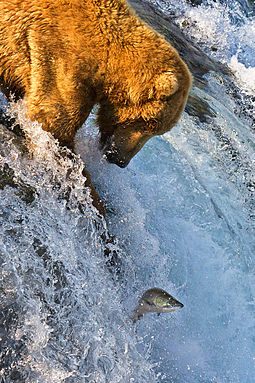
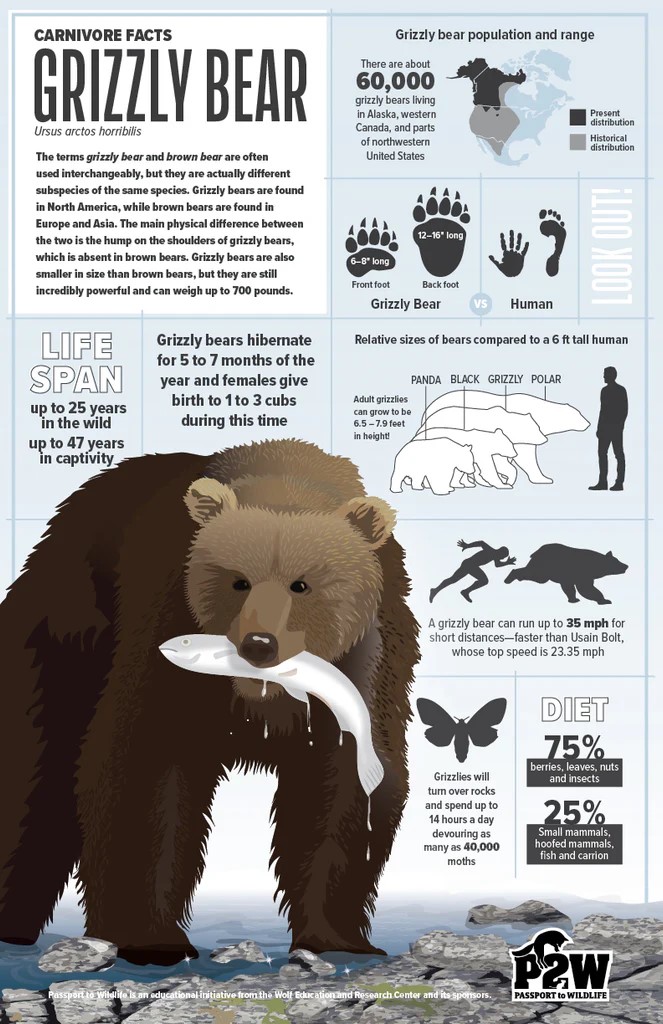
Although grizzlies are of the order Carnivora and have the digestive system of carnivores, they are normally omnivores: their diets consist of both plants and animals. They have been known to prey on large mammals, when available, such as moose, elk, caribou, white-tailed deer, mule deer, bighorn sheep, bison, and even black bears, though they are more likely to take calves and injured individuals rather than healthy adults. Grizzly bears feed on fish such as salmon, trout, and bass, and those with access to a more protein-enriched diet in coastal areas potentially grow larger than inland individuals. Grizzly bears also readily scavenge food or carrion left behind by other animals. Grizzly bears will also eat birds and their eggs, and gather in large numbers at fishing sites to feed on spawning salmon. They frequently prey on baby deer left in the grass, and occasionally they raid the nests of raptors such as bald eagles. Coastal Canadian and Alaskan grizzlies are larger than those that reside in the Rocky Mountains. This is due, in part, to the richness of their diets. In Yellowstone National Park in the United States, the grizzly bear's diet consists mostly of whitebark pine nuts, tubers, grasses, various rodents, army cutworm moths, and scavenged carcasses. None of these, however, match the fat content of the salmon available in Alaska and British Columbia. With the high fat content of salmon, it is not uncommon to encounter grizzlies in Alaska weighing 540 kg (1,200 lb). Grizzlies in Alaska supplement their diet of salmon and clams with sedge grass and berries. In areas where salmon are forced to leap waterfalls, grizzlies gather at the base of the falls to feed on and catch the fish. Salmon are at a disadvantage when they leap waterfalls because they cluster together at their bases and are therefore easier targets for the grizzlies. Grizzly bears are well-documented catching leaping salmon in their mouths at Brooks Falls in Katmai National Park and Preserve in Alaska. They are also very experienced in chasing the fish around and pinning them with their claws. At such sites such as Brooks Falls and McNeil Falls in Alaska, big male grizzlies fight regularly for the best fishing spots. Grizzly bears along the coast also forage for razor clams, and frequently dig into the sand to seek them. During the spring and fall, directly before and after the salmon runs, berries and grass make up the mainstay of the diets of coastal grizzlies. Inland grizzlies may eat fish too, most notably in Yellowstone grizzlies eating Yellowstone cutthroat trout. The relationship with cutthroat trout and grizzlies is unique because it is the only example where Rocky Mountain grizzlies feed on spawning salmonid fish. However, grizzly bears themselves and invasive lake trout threaten the survival of the trout population and there is a slight chance that the trout will be eliminated.
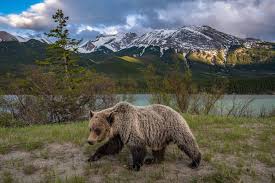
Grizzly bears occasionally prey on small mammals, such as marmots, ground squirrels, lemmings, and voles. The most famous example of such predation is in Denali National Park and Preserve, where grizzlies chase, pounce on, and dig up Arctic ground squirrels to eat. In some areas, grizzly bears prey on hoary marmots, overturning rocks to reach them, and in some cases preying on them when they are in hibernation. Larger prey includes bison and moose, which are sometimes taken by bears in Yellowstone National Park. Because bison and moose are dangerous prey, grizzlies usually use cover to stalk them and/or pick off weak individuals or calves. Grizzlies in Alaska also regularly prey on moose calves, which in Denali National Park may be their main source of meat. In fact, grizzly bears are such important predators of moose and elk calves in Alaska and Yellowstone that they may kill as many as 51 percent of elk or moose calves born that year. Grizzly bears have also been blamed in the decline of elk in Yellowstone National Park when the actual predators were thought to be gray wolves. In northern Alaska, grizzlies are a significant predator of caribou, mostly taking sick or old individuals or calves. Several studies show that grizzly bears may follow the caribou herds year-round in order to maintain their food supply. In northern Alaska, grizzly bears often encounter muskox. Despite the fact that muskox do not usually occur in grizzly habitat and that they are bigger and more powerful than caribou, predation on muskox by grizzlies has been recorded. Grizzlies along the Alaskan coast also scavenge on dead or washed up whales. Usually such incidents involve only one or two grizzlies at a carcass, but up to ten large males have been seen at a time eating a dead humpback whale. Dead seals and sea lions are also consumed. Although the diets of grizzly bears vary extensively based on seasonal and regional changes, plants make up a large portion of them, with some estimates as high as 80–90%. Various berries constitute an important food source when they are available. These can include blueberries, blackberries (Rubus fruticosus), salmon berries (Rubus spectabilis), cranberries (Vaccinium oxycoccos), buffalo berries (Shepherdia argentea), soapberries (Shepherdia canadensis), and huckleberries (Vaccinium parvifolium), depending on the environment. Insects such as ladybugs, ants, and bees are eaten if they are available in large quantities. In Yellowstone National Park, grizzly bears may obtain half of their yearly caloric needs by feeding on miller moths that congregate on mountain slopes. When food is abundant, grizzly bears will feed in groups. For example, many grizzly bears will visit meadows right after an avalanche or glacier slide. This is due to an influx of legumes, such as Hedysarum, which the grizzlies consume in massive amounts. When food sources become scarcer, however, they separate once again.
The grizzly bear has several relationships with its ecosystem. One such relationship is a mutualistic relationship with fleshy-fruit bearing plants. After the grizzly consumes the fruit, the seeds are excreted and thereby dispersed in a germinable condition. Some studies have shown germination success is indeed increased as a result of seeds being deposited along with nutrients in feces. This makes grizzly bears important seed distributors in their habitats. While foraging for tree roots, plant bulbs, or ground squirrels, bears stir up the soil. This process not only helps grizzlies access their food, but also increases species richness in alpine ecosystems. An area that contains both bear digs and undisturbed land has greater plant diversity than an area that contains just undisturbed land. Along with increasing species richness, soil disturbance causes nitrogen to be dug up from lower soil layers, and makes nitrogen more readily available in the environment. An area that has been dug by the grizzly bear has significantly more nitrogen than an undisturbed area. Nitrogen cycling is not only facilitated by grizzlies digging for food, it is also accomplished via their habit of carrying salmon carcasses into surrounding forests. It has been found that spruce tree (Picea glauca) foliage within 500 m (1,600 ft) of the stream where the salmon have been obtained contains nitrogen originating from salmon on which the bears preyed. These nitrogen influxes to the forest are directly related to the presence of grizzly bears and salmon. Grizzlies directly regulate prey populations and also help prevent overgrazing in forests by controlling the populations of other species in the food chain. An experiment in Grand Teton National Park in Wyoming in the United States showed removal of wolves and grizzly bears caused populations of their herbivorous prey to increase. This, in turn, changed the structure and density of plants in the area, which decreased the population sizes of migratory birds. This provides evidence grizzly bears represent a keystone predator, having a major influence on the entire ecosystem they inhabit. When grizzly bears fish for salmon along the coasts of Alaska and British Columbia, they often only eat the skin, brain and roe of the fish. In doing so, they provide a food source for gulls, ravens, and foxes, all of which eat salmon as well; this benefits both the bear and the smaller predators.