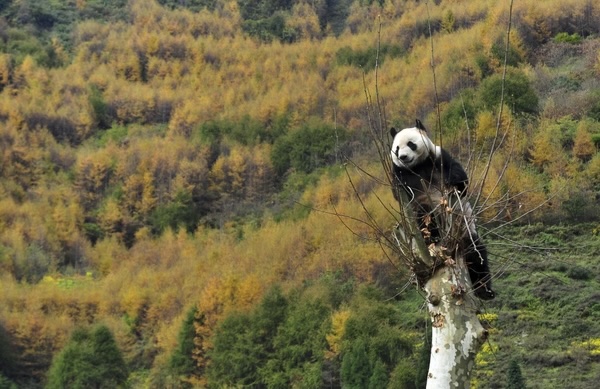
A photo of a panda in Sichuan, China
Giant pandas live in a few mountain ranges in south-central China, in Sichuan, Shaanxi, and the Gansu provinces. They once lived in lowland areas, but farming, forest clearing, and other development now restrict giant pandas to the mountains.
Giant pandas live in broadleaf and coniferous forests with a dense understory of bamboo, at elevations between 5,000 and 10,000 feet. Torrential rains or dense mist throughout the year characterize these forests, often shrouded in heavy clouds.
Sichuan is a province in Southwestern China.
A photo of a panda in Sichuan, China
Sichuan occupies the Sichuan Basin and Tibetan Plateau - between the Jinsha River to the west, the Daba Mountains to the north, and the Yunnan-Guizhou Plateau to the south. Its capital city is Chengdu, and its population stands at 83 million. Sichuan neighbors Qinghai and Gansu to the north, Shaanxi and Chongqing to the east, Guizhou and Yunnan to the south, and Tibet to the west.
The Sichuan Giant Panda Sanctuaries, located in southwest Sichuan province of China, is home to more than 30% of the world's giant pandas and is among the most important sites for the captive breeding of these pandas. It covers 9245 km² with seven nature reserves and nine scenic parks in the Qionglai and Jiajin Mountains.
Shaanxi is a province in Northwestern China.
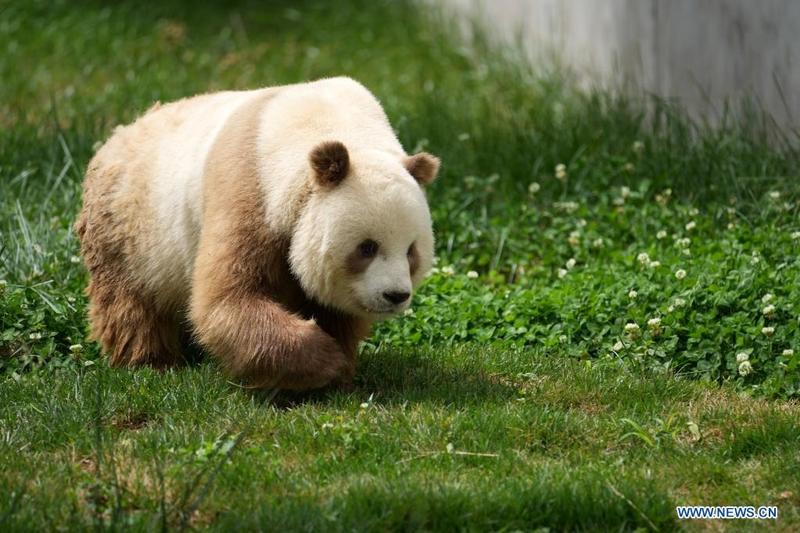
A photo of a panda in Shaanxi, China
It borders the province-level divisions of Inner Mongolia to the north, Shanxi and Henan to the east, Hubei, Chongqing, and Sichuan to the south, and Gansu and Ningxia to the west. Shaanxi covers an area of over 79,000 square miles with about 37 million people, the 16th largest in China.
The Shaanxi government has officially sanctioned five new panda reserves and five panda corridors, increasing the protected areas in Qinling by 150,000 hectares. The five new giant panda reserves are Motian Qinling Reserve, Guanyinshan Reserve, Sangyuan Reserve, Ningshan Reserve, and Tianhuashan Reserve.
Gansu is a province in Northwestern China.
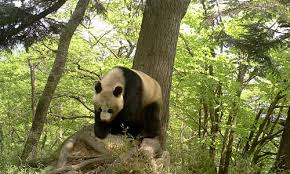
A photo of a panda in Gansu, China
Its capital and largest city is Lanzhou, in the southwestern part of the province. The seventh-largest administrative district by area of 175,200 sq mi, Gansu lies between the Tibetan and Loess plateaus and borders Mongolia's Govi-Altai Province, Inner Mongolia, and Ningxia to the north, Xinjiang and Qinghai to the west, Sichuan to the south, and Shaanxi to the east. The Yellow River passes through the southern part of the province. Part of Gansu's territory is located in the Gobi Desert. The Qilian Mountains are located in the south of the province.
Gansu, along with Sichuan and Shaanxi, is home to a significant portion of the remaining wild panda population. There are over 60 nature reserves in China, including those in Gansu, to protect panda habitat.