
Saving The Red Panda

About The Red Panda

Overview:

red randa resting on tree branch
A red panda in it's natural habitat

The red panda (Ailurus fulgens), also known as the lesser panda, is a small mammal native to the eastern Himalayas and southwestern China. It has dense reddish-brown fur with a black belly and legs, white-lined ears, a mostly white muzzle and a ringed tail. Its head-to-body length is 51–63.5 cm (20.1–25.0 in) with a 28–48.5 cm (11.0–19.1 in) tail, and it weighs between 3.2 and 15 kg (7.1 and 33.1 lb). It is well adapted to climbing due to its flexible joints and curved semi-retractile claws.

The red panda was formally described in 1825. The two currently recognised subspecies, the Himalayan and the Chinese red panda, genetically diverged about 250,000 years ago. The red panda's place on the evolutionary tree has been debated, but modern genetic evidence places it in close affinity with raccoons, weasels, and skunks. It is not closely related to the giant panda, which is a bear, though both possess elongated wrist bones or "false thumbs" used for grasping bamboo. The evolutionary lineage of the red panda (Ailuridae) stretches back around 25 to 18 million years ago, as indicated by extinct fossil relatives found in Eurasia and North America.
Physical Characteristics

Appearance:

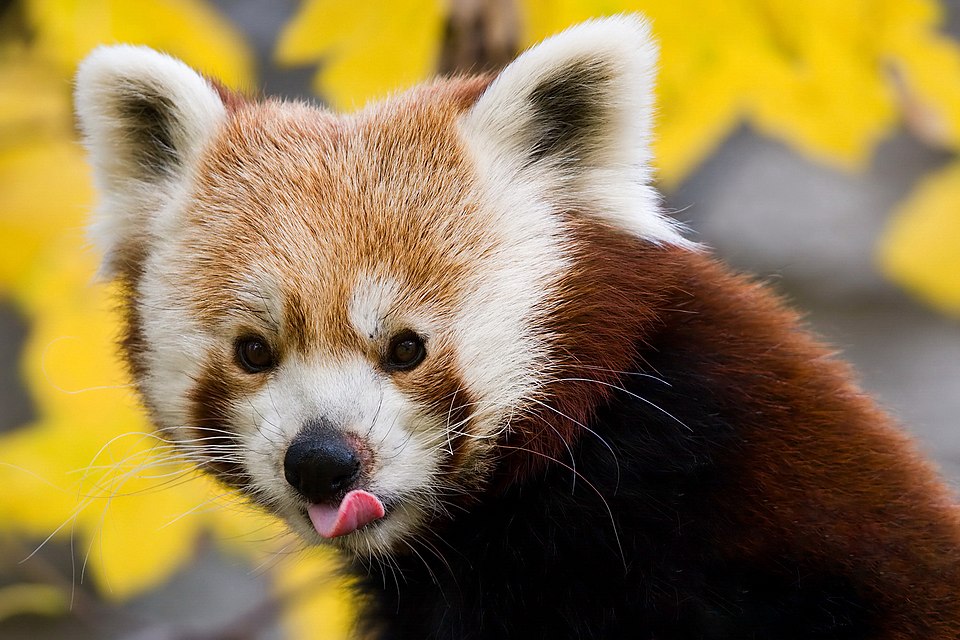
The red panda's coat is mainly red or orange-brown with a black belly and legs. The muzzle, cheeks, brows and inner ear margins are mostly white while the bushy tail has red and buff ring patterns and a dark brown tip. The colouration appears to serve as camouflage in habitat with red moss and white lichen-covered trees. The guard hairs are longer and rougher while the dense undercoat is fluffier with shorter hairs. The guard hairs on the back have a circular cross-section and are 47–56 mm (1.9–2.2 in) long. It has moderately long whiskers around the mouth, lower jaw and chin. The hair on the soles of the paws allows the animal to walk in snow.

The red panda has a relatively small head, though proportionally larger than in similarly sized raccoons, with a reduced snout and triangular ears, and nearly evenly lengthed limbs. It has a head-body length of 51–63.5 cm (20.1–25.0 in) with a 28–48.5 cm (11.0–19.1 in) tail. The Himalayan red panda is recorded to weigh 3.2–9.4 kg (7.1–20.7 lb), while the Chinese red panda weighs 4–15 kg (8.8–33.1 lb) for females and 4.2–13.4 kg (9.3–29.5 lb) for males. It has five curved digits on each foot, each with curved semi-retractile claws that aid in climbing. The pelvis and hindlimbs have flexible joints, adaptations for an arboreal quadrupedal lifestyle. While not prehensile, the tail helps the animal balance while climbing.

red panda's face
The unique face of a red panda