
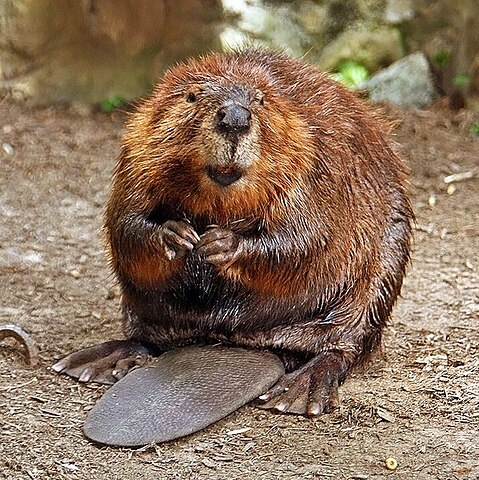
North American beavers have also been introduced into South America (Patagonia) and Europe (primarily Finland and Karelia).
The North American Beaver is often referred to simply as "beaver," although this can cause some confusion because another distantly related rodent, Aplodontia rufa, is often called the "mountain beaver." Other vernacular names, including American beaver and Canadian beaver, distinguish this species from the other extant beaver species, Castor fiber, which is native to Eurasia.
The beaver is the largest rodent in North America and competes with its Eurasian counterpart, the European beaver, for being the third-largest in the world, both following the South American capybara and lesser capybara. The European species is slightly larger on average but the American has a larger known maximum size. Adults usually weigh from 11 to 32 kg (24 to 71 lb), with 20 kg (44 lb) being typical.
In 19th century, beaver populations across the United States were nearing extinction due to the fur trade. A 1901 article in the Los Angeles Herald highlights the American public's awareness of the declining beaver population. The reporter mentions that the minister of the Province of Ontario gifted Van Sant, the Governor of Minneapolis, four live beavers. These animals were intended to establish a new colony at Itasca Park. While beavers as a diplomatic gift might seem strange initially, the article notes that the beaver population in the United States has been nearly hunted to extinction, as records from the early 1800s show that up to 200,000 beaver skins were shipped annually from the United States to European markets. In 1911, the California State Legislature enacted legislation (Sec.626P, Fish and Game Code, 1911-1912) to protect beavers fully. The effort to conserve California’s beaver population was initially enacted to sustain the fur trade's longevity.
Efforts to protect beavers have included relocation and reintroduction programs. From 1923 to 1949, the U.S. Forest Service subsidized beaver planting initiatives in designated non-agricultural areas. The Forest Service implemented eight planting attempts between 1934 and August 1938 to recover beaver populations. Beavers were transplanted from agricultural counties in Southern Idaho and relocated to Northern California counties. Beavers were even dropped from airplanes using boxes with parachutes attached in the El Dorado National Forest. Beavers were also frequently moved away from fertile farmland to less valuable ranchlands and woodlands. From 1945 through 1955, the Department of Fish and Game relocated 3,000 beavers to appropriate waterways. This procedure was beneficial to ranchers, farmers, and conservationists
The first fossil records of beavers are 10 to 12 million years old in Germany, and they are thought to have migrated to North America across the Bering Strait.The oldest fossil record of beavers in North America are of two beaver teeth near Dayville, Oregon, and are 7 million years old
At one time, 25 subspecies of beavers were identified in North America, with distinctions based primarily on slight morphological differences and geographical isolation at the time of discovery.
However, modern techniques generally use genetics rather than morphology to distinguish between subspecies, and currently the Integrated Taxonomic Information System (which provides authoritative taxonomic information on plants, animals, fungi, and microbes of North America and the world) does not recognize any subspecies of C. canadensis, though a definitive genetic analysis has not been performed.
Such an analysis would be complicated by the fact that substantial genetic mixing of populations has occurred because of the numerous reintroduction efforts intended to help the species recover following extirpation from many regions.Go to the top of the page