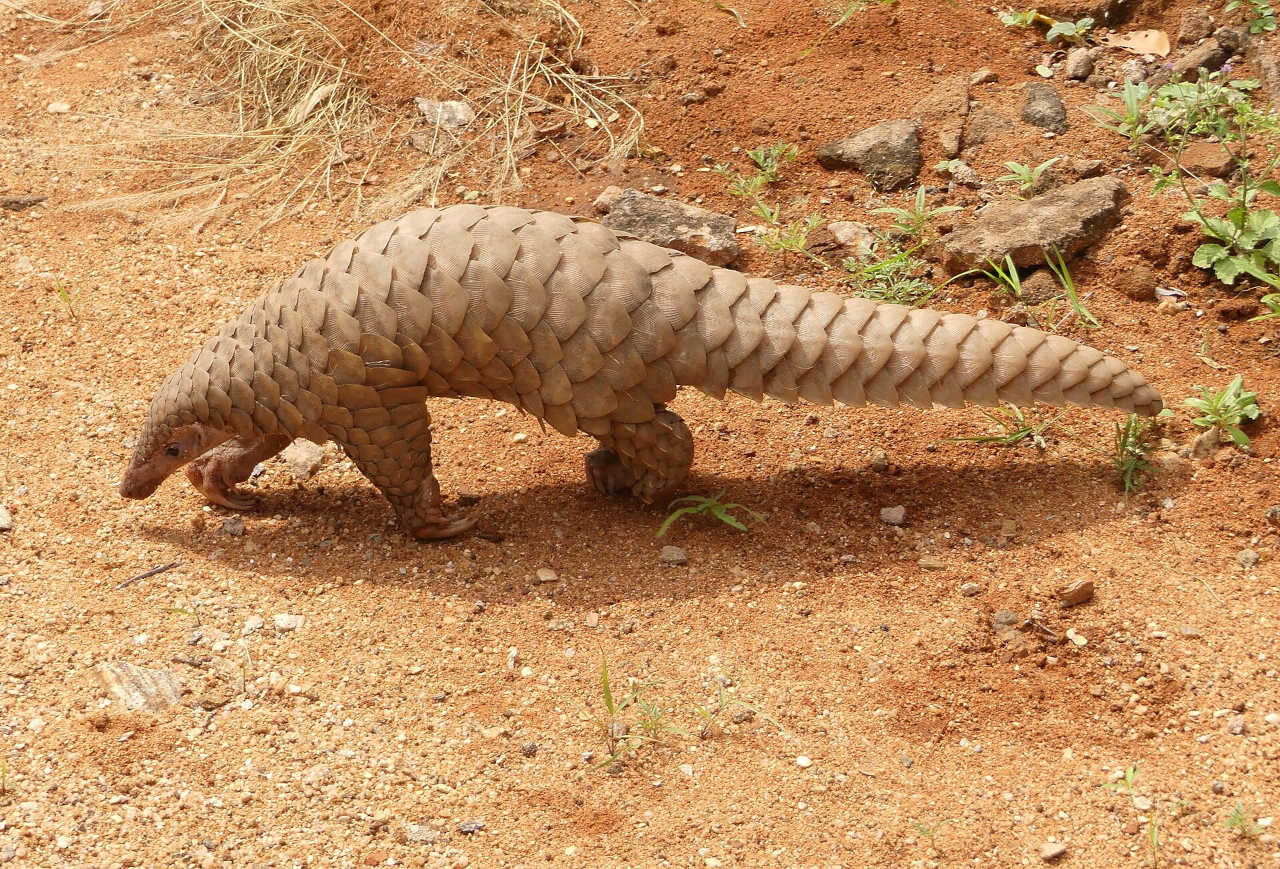
Pangolins, sometimes known as scaly anteaters, are mammals of the order Pholidota. The one extant family, the Manidae, has three genera: Manis, Phataginus, and Smutsia. Manis comprises four species found in Asia, while Phataginus and Smutsia include two species each, all found in sub-Saharan Africa. These species range in size from 30 to 100 cm. Several extinct pangolin species are also known. In September 2023, nine species were reported.
Pangolins have large, protective keratin scales, similar in material to fingernails and toenails, covering their skin; they are the only known mammals with this feature. Depending on the species, they live in hollow trees or burrows. Pangolins are nocturnal, and their diet consists of mainly ants and termites, which they capture using their long tongues. They tend to be solitary animals, meeting only to mate and produce a litter of one to three offspring, which they raise for about two years. Pangolins superficially resemble armadillos, though the two are not closely related; they have undergone convergent evolution.
Pangolins are threatened by poaching (for their meat and scales, which are used in traditional medicine) and heavy deforestation of their natural habitats, and are the most trafficked mammals in the world. As of January 2020, there are eight species of pangolin whose conservation status is listed in the threatened tier. Three (Manis culionensis, M. pentadactyla and M. javanica) are critically endangered, three (Phataginus tricuspis, Manis crassicaudata and Smutsia gigantea) are endangered and two (Phataginus tetradactyla and Smutsia temminckii) are vulnerable on the Red List of Threatened Species of the International Union for Conservation of Nature.
The physical appearance of a pangolin is marked by large, hardened, overlapping, plate-like scales, which are soft on newborn pangolins, but harden as the animal matures. They are made of keratin, the same material from which human fingernails and tetrapod claws are made, and are structurally and compositionally very different from the scales of reptiles. The pangolin's scaled body is comparable in appearance to a pine cone. It can curl up into a ball when threatened, with its overlapping scales acting as armor, while it protects its face by tucking it under its tail. The scales are sharp, providing extra defense from predators.
Pangolins can emit a noxious-smelling chemical from glands near the anus, similar to the spray of a skunk. They have short legs, with sharp claws which they use for burrowing into ant and termite mounds and for climbing.
The tongues of pangolins are extremely long, and like those of the giant anteater and the tube-lipped nectar bat, the root of the tongue is not attached to the hyoid bone but is in the thorax between the sternum and the trachea. Large pangolins can extend their tongues as much as 40 cm (16 in), with a diameter of only about 0.5 cm.
It is actually quite difficult to get a reliably sourced recording of what pangolins sound like, so instead here is a recording of one rolling around in the dirt. You can hear how much its scales grind and crunch on the gravel.
Wikipedia contributors. (2025, January 23). Pangolin. In Wikipedia, The Free Encyclopedia. Retrieved 03:48, February 4, 2025, from https://en.wikipedia.org/w/index.php?title=Pangolin&oldid=1271258482