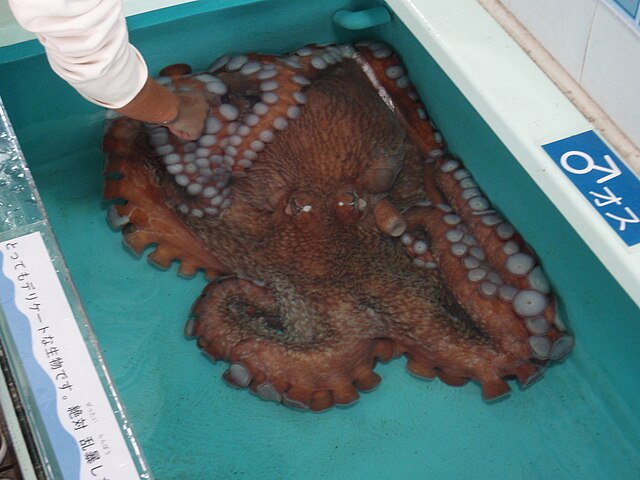
Octopuses are considered to be mostly solitary though a few are known to occur in high densities and interact regularly, usually in the context of dominance and reproductive competition. This is likely the result of abundant food supplies combined with less den sites. The Larger Pacific striped octopus has been described as particularly social, living in groups of up to 40 individuals. Octopuses hide in dens, which are typically crevices in rocky or other hard structures, including man-made ones. Small species will even use abandoned shells and bottles. They can navigate back to a den without having to retrace their outward route. They are not migratory.
Octopuses bring captured prey to the den to eat. Dens are often surrounded by a midden of dead and uneaten food items. These middens may attract scavengers like fish, molluscs and echinoderms. On rare occasions, octopuses hunt cooperatively with other species, with fish as their partners. They regulate the species composition of the hunting group — and the behavior of their partners — by punching them.
All information for the Octopus comes from This wikipedia page