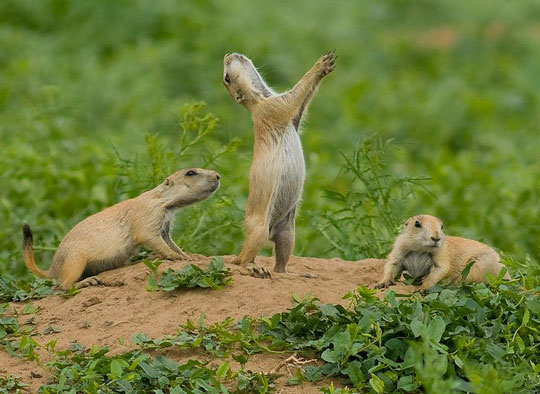
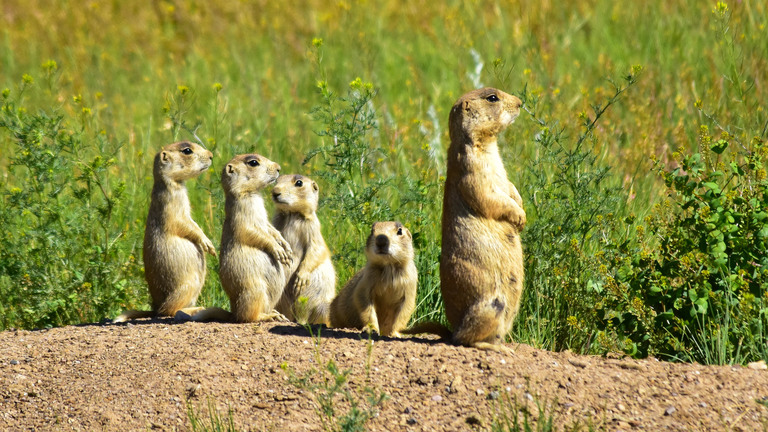
Prarie Dogs are highly social animals. They live in large colonies or "towns", and collections of prairie dog families can span hundreds of acres. The prairie dog family groups are the most basic units of its society.[20] Members of a family group inhabit the same territory.[13] Family groups of black-tailed and Mexican prairie dogs are called "coteries", while "clans" describes family groups of white-tailed, Gunnison's, and Utah prairie dogs.[13] Although these two family groups are similar, coteries tend to be more closely knit than clans.[21] Members of a family group interact through oral contact or "kissing" and grooming one another.[19][20] They do not perform these behaviors with prairie dogs from other family groups.[20]
The prairie dog is well adapted to predators. Using its dichromatic color vision, it can detect predators from a great distance; it then alerts other prairie dogs of the danger with a special, high-pitched call. Constantine Slobodchikoff and others assert that prairie dogs use a sophisticated system of vocal communication to describe specific predators.[25] According to them, prairie dog calls contain specific information as to what the predator is, how big it is and how fast it is approaching. These have been described as a form of grammar. According to Slobodchikoff, these calls, with their individuality in response to a specific predator, imply that prairie dogs have highly developed cognitive abilities.[25] He also writes that prairie dogs have calls for things that are not predators to them. This is cited as evidence that the animals have a very descriptive language and have calls for any potential threat.[25]