Studies in the 1990s by the ethologists Stanley D. Gehrt and Ulf Hohmann suggest that
raccoons engage in sex-specific social behaviors and are not typically solitary, as was
previously thought. Related females often live in a so-called "fission-fusion society";
that is, they share a common area and occasionally meet at feeding or resting grounds.
Unrelated males often form loose male social groups to maintain their position against
foreign males during the mating season—or against other potential invaders. Such a
group does not usually consist of more than four individuals. Since some males show
aggressive behavior towards unrelated kits, mothers will isolate themselves from other
raccoons until their kits are big enough to defend themselves.
With respect to these three different modes of life prevalent among raccoons, Hohmann
called their social structure a "three-class society." Samuel I. Zeveloff, professor
of zoology at Weber State University and author of the book Raccoons: A Natural History,
is more cautious in his interpretation and concludes at least the females are solitary
most of the time and, according to Erik K. Fritzell's study in North Dakota in 1978,
males in areas with low population densities are solitary as well.
The shape and size of a raccoon's home range varies depending on age, sex, and habitat,
with adults claiming areas more than twice as large as juveniles. While the size of home
ranges in the habitat of North Dakota's prairies lie between 7 and 50 km² (3 and 20 sq mi)
for males and between 2 and 16 km² (1 and 6 sq mi) for females, the average size in a marsh
at Lake Erie was 0.5 km² (0.19 sq mi). Irrespective of whether the home ranges of adjacent
groups overlap, they are most likely not actively defended outside the mating season if
food supplies are sufficient. Odor marks on prominent spots are assumed to establish home
ranges and identify individuals. Urine and feces left at shared raccoon latrines may
provide additional information about feeding grounds, since raccoons were observed to
meet there later for collective eating, sleeping and playing.
Concerning the general behavior patterns of raccoons, Gehrt points out that "typically
you'll find 10 to 15 percent that will do the opposite" of what is expected.
Diet
Though usually nocturnal, the raccoon is sometimes active in daylight to take advantage
of available food sources. Its diet consists of about 40% invertebrates, 33% plant material,
and 27% vertebrates. Since its diet consists of such a variety of different foods, Zeveloff
argues the raccoon "may well be one of the world's most omnivorous animals." While its diet
in spring and early summer consists mostly of insects, worms, and other animals already
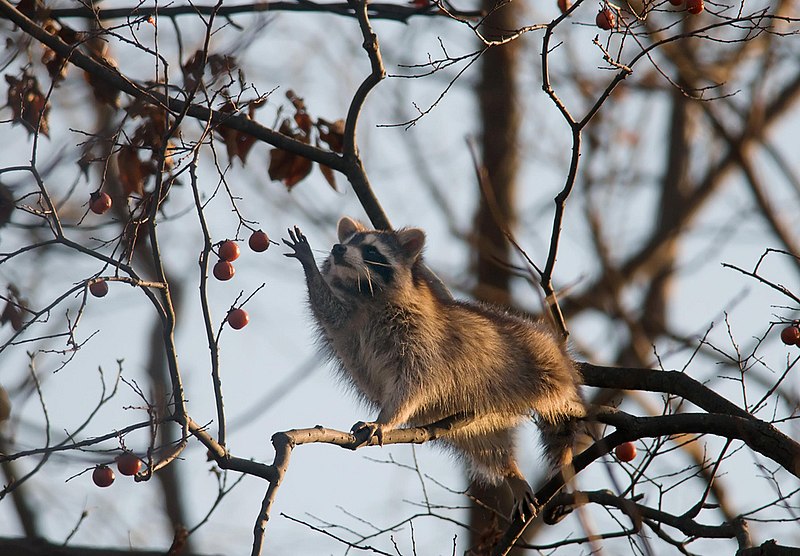
available early in the year, it prefers fruits and nuts, such as acorns and walnuts, which
emerge in late summer and autumn, and represent a rich calorie source for building up fat
needed for winter.
Contrary to popular belief, raccoons only occasionally eat active or large prey, such as
birds and mammals. They prefer prey that is easier to catch, specifically crayfish, insects,
fish, amphibians, and bird eggs. Raccoons are virulent predators of eggs and hatchlings in
both birds and reptile nests, to such a degree that, for threatened prey species, raccoons
may need to be removed from the area or nests may need to be relocated to mitigate the effect
of their predations (i.e. in the case of some globally threatened turtles). When food is
plentiful, raccoons can develop strong individual preferences for specific foods. In the
northern parts of their range, raccoons go into a winter rest, reducing their activity
drastically as long as a permanent snow cover makes searching for food difficult.
One aspect of raccoon behavior is so well known that it gives the animal part of its
scientific name, Procyon lotor; lotor is Latin for 'washer'. In the wild, raccoons often
dabble for underwater food near the shoreline. They then often pick up the food item with
their front paws to examine it and rub the item, sometimes to remove unwanted parts. This
gives the appearance of the raccoon "washing" the food. The tactile sensitivity of raccoons'
paws is increased if this rubbing action is performed underwater, since the water softens the
hard layer covering the paws. However, the behavior observed in captive raccoons in which
they carry their food to water to "wash" or douse it before eating has not been observed in
the wild. Naturalist Georges-Louis Leclerc, Comte de Buffon, believed that raccoons do not
have adequate saliva production to moisten food, thereby necessitating dousing, but this
hypothesis is now considered to be incorrect. Captive raccoons douse their food more
frequently when a watering hole with a layout similar to a stream is not farther away
than 3 m (10 ft). The widely accepted theory is that dousing in captive raccoons is a
fixed action pattern from the dabbling behavior performed when foraging at shores for
aquatic foods. This is supported by the observation that aquatic foods are doused more
frequently. Cleaning dirty food does not seem to be a reason for "washing".
Raccoons usually mate in a period triggered by increasing daylight between late January
and mid-March. However, there are large regional differences which are not completely
explicable by solar conditions. For example, while raccoons in southern states typically
mate later than average, the mating season in Manitoba also peaks later than usual in March
and extends until June. During the mating season, males restlessly roam their home ranges
in search of females in an attempt to court them during the three- to four-day period when
conception is possible. These encounters will often occur at central meeting places.
Copulation, including foreplay, can last over an hour and is repeated over several nights.
The weaker members of a male social group also are assumed to get the opportunity to mate,
since the stronger ones cannot mate with all available females. In a study in southern Texas
during the mating seasons from 1990 to 1992, about one third of all females mated with more
than one male. If a female does not become pregnant or if she loses her kits early, she will
sometimes become fertile again 80 to 140 days later.
After usually 63 to 65 days of gestation (although anywhere from 54 to 70 days is possible),
a litter of typically two to five young is born. The average litter size varies widely with
habitat, ranging from 2.5 in Alabama to 4.8 in North Dakota. Larger litters are more common
in areas with a high mortality rate, due, for example, to hunting or severe winters. While
male yearlings usually reach their sexual maturity only after the main mating season, female
yearlings can compensate for high mortality rates and may be responsible for about 50% of all
young born in a year.
Males have no part in raising young. The kits (also called "cubs") are
blind and deaf at birth, but their mask is already visible against their light fur. The birth
weight of the roughly 10 cm (4 in)-long kits is between 60 and 75 g (2.1 and 2.6 oz). Their
ear canals open after around 18 to 23 days, a few days before their eyes open for the first
time. Once the kits weigh about 1 kg (2 lb), they begin to explore outside the den, consuming
solid food for the first time after six to nine weeks. After this point, their mother suckles
them with decreasing frequency; they are usually weaned by 16 weeks. In the fall, after their
mother has shown them dens and feeding grounds, the juvenile group splits up. While many females
will stay close to the home range of their mother, males can sometimes move more than 20 km
(12 mi) away. This is considered an instinctive behavior, preventing inbreeding. However,
mother and offspring may share a den during the first winter in cold areas.
Life expectancy
Captive raccoons have been known to live for more than 20 years. However, the species'
life expectancy in the wild is only 1.8 to 3.1 years, depending on the local conditions
such as traffic volume, hunting, and weather severity. It is not unusual for only half of
the young born in one year to survive a full year. After this point, the annual mortality
rate drops to between 10% and 30%. Young raccoons are vulnerable to losing their mother and
to starvation, particularly in long and cold winters. The most frequent natural cause of
death in the North American raccoon population is distemper, which can reach epidemic
proportions and kill most of a local raccoon population. In areas with heavy vehicular
traffic and extensive hunting, these factors can account for up to 90% of all deaths of
adult raccoons. The most important natural predators of the raccoon are bobcats, coyotes,
and great horned owls, the latter mainly preying on young raccoons but capable of killing
adults in some cases. In Florida, they have been reported to fall victim to larger carnivores
like American black bear and cougars and these species may also be a threat on occasion in
other areas. Where still present, gray wolves may still occasionally take raccoons as a
supplemental prey item. Also in the southeast, they are among the favored prey for adult
American alligators. On occasion, both bald and golden eagles will prey on raccoons.
In the tropics, raccoons are known to fall prey to smaller eagles such as ornate hawk-eagles
and black hawk-eagles, although it is not clear whether adults or merely juvenile raccoons
are taken by these. In rare cases of overlap, they may fall victim from carnivores ranging
from species averaging smaller than themselves such as fishers to those as large and formidable
as jaguars in Mexico. In their introduced range in the former Soviet Union, their main predators
are wolves, lynxes, and Eurasian eagle-owls. However, predation is not a significant cause of
death, especially because larger predators have been exterminated in many areas inhabited by
raccoons.
.jpg)
