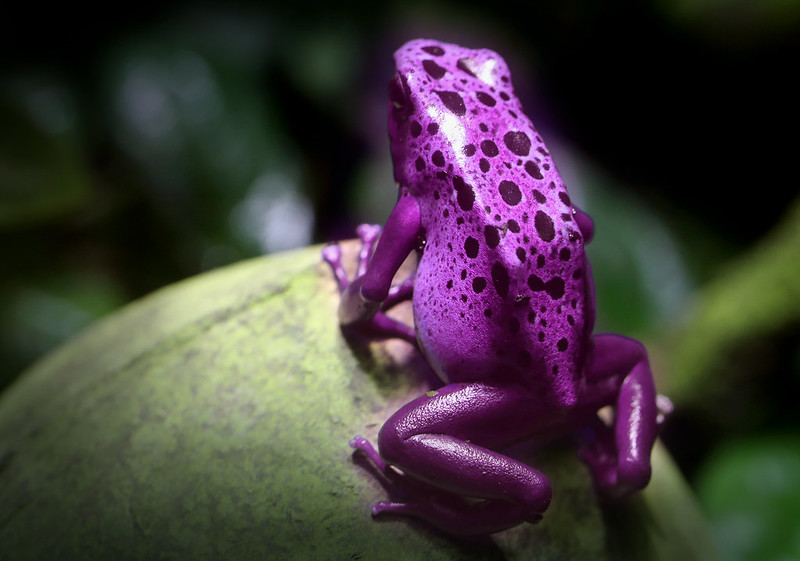
The Dendrobatidae are a family of species very well known for their territorial and aggressive behavior not only as tadpoles, but as adults too. These aggression behaviors are not only limited to males, as many female Dendrobatidae also are known to defend their own native territory very aggressively.[48] Dendrobatidae are especially aggressive in defending regions that serve as male calling sites.[48] Males wrestle with intruders of their territory in order to defend their calling sites as well as their vegetation.[48] While vocalization and various behavioral displays serve as a way of exhibiting one's strength or fitness, territorial disputes and fights often escalate to physical combat and aggression.[48] Physical violence and aggression are particularly common at times of calling. If it an intruder is detected making calls in the territory of a Dendrobatidae frog, the resident frog attempts to eliminate the competition to claim the territory and the females in it for himself.[48] The resident frog initially makes its presence known by the means of vocalization and various behavioral displays as a way to exert dominance, but if this does not scare away the intruder, then the resident frog moves towards the intruder and strikes them.[48] These encounters immediately escalate into a full on fight where both strike each other and grasp each other's limbs.[48] Similarly, the females also often get into fights and display aggressive behaviors in disputes over territory or a mating conflict. It has also been observed that females who are going after the same male, after hearing their call, chase each other down and wrestle to fight for the male.[49] After a female courts with a male, they are also very likely to exhibit aggressive behavior towards any females that approach that male.[49] Both the males and females bout their own respective sexes for each other in a fairly similar fashion.[49]
Many species of poison dart frogs are dedicated parents. Many poison dart frogs in the genera Oophaga and Ranitomeya carry their newly hatched tadpoles into the canopy; the tadpoles stick to the mucus on the backs of their parents. Once in the upper reaches of the rainforest trees, the parents deposit their young in the pools of water that accumulate in epiphytic plants, such as bromeliads. The tadpoles feed on invertebrates in their nursery, and their mother will even supplement their diet by depositing eggs into the water. Other poison frogs lay their eggs on the forest floor, hidden beneath the leaf litter. Poison frogs fertilize their eggs externally; the female lays a cluster of eggs and a male fertilizes them afterward, in the same manner as most fish. Poison frogs can often be observed clutching each other, similar to the manner most frogs copulate. However, these demonstrations are actually territorial wrestling matches. Both males and females frequently engage in disputes over territory. A male will fight for the most prominent roosts from which to broadcast his mating call; females fight over desirable nests, and even invade the nests of other females to devour competitor's eggs.[50]
The operational sex ratio in the poison dart frog family is mostly female biased. This leads to a few characteristic behaviors and traits found in organisms with an uneven sex ratio. In general, females have a choice of mate. In turn, males show brighter coloration, are territorial, and are aggressive toward other males. Females select mates based on coloration (mainly dorsal), calling perch location, and territory.[14]