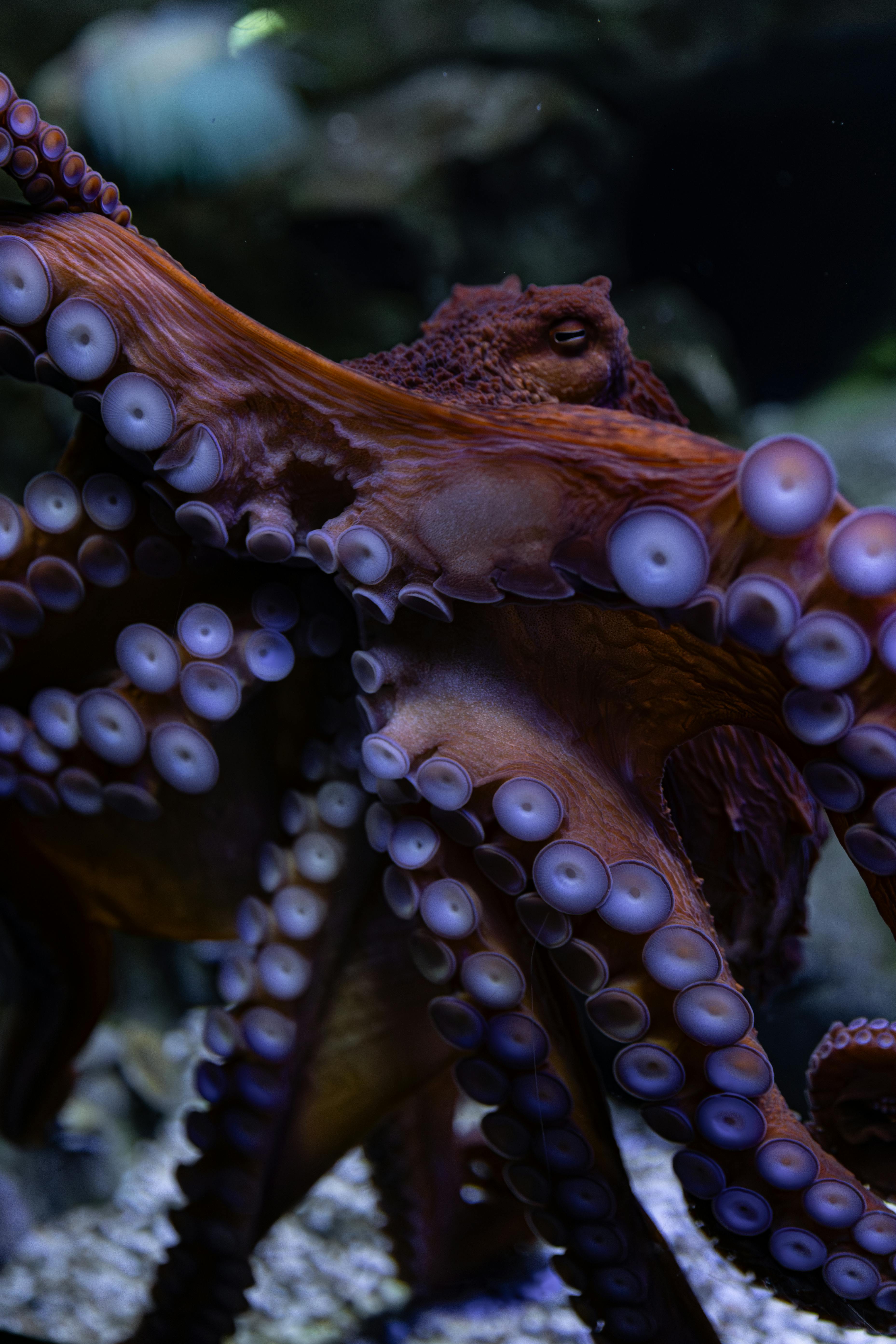
Octopus can slither into tight spaces and change shape to confuse predators. They can alter their colors to match their surroundings and squirt clouds of black ink to make an escape. Octopuses are bottom dwellers and are not found in open water. Although they may venture onto dry land in pursuit of a crab, if they remain there for more than half an hour they will die from suffocation.
Octopuses are largely solitary creatures and spend much of their short lives in hiding. Most species hide in holes, crevasses and burrows during the day, often covering their hiding place with rocks, and hunt at night. They feed on shrimp, clams and crabs and other crustaceans and mollusks. With the exception of mating rituals, they live alone, concentrating on housing and feeding. They tend to be territorial (defend an area within the home range). If they encounter a member of their own species, there is always "psychological advantage" for the individual defending its own territory. If confrontation does lead to competition, octopuses attack competitors and rivals the same way they do with prey. [Source: Kelly Ray, Animal Diversity Web (ADW)]
Octopuses are rarely seen swimming around. They tend to hide in crevices amongst rocks, inside seashells, and discarded bottles and cans. Their soft-bodies are vulnerable to attacks from predators. They often place shells, rocks, hollowed-out legs of various crustaceans and human litter immediately in front of the openings to their lairs. They often occupy a particular hiding place for a long time and venture out only to hunt for food or look for a mate. However, they often can’t resist a new hiding place when one is offered that is why fishermen can catch them by dropping pots in the water. [Source: Kelly Ray, Animal Diversity Web (ADW)]
Octopuses communicate with vision and touch and sense using vision and sound. According to Animal Diversity Web: In general, all octopuses have high-acuity-lens eyes on the sides of their heads. This placement forces them to use monocular vision, which means they only use one eye at a time. They are also color blind, but are able to distinguish between different hues and brightnesses. Octopuses respond to sound and use it as a way to find prey. [Source: Lindsey Lee, Animal Diversity Web (ADW)]
Octopuses have various ways of communicating among themselves. These organisms have a sender-receiver match (a species-specific vocalization) that allows them to communicate with each other. Octopuses use a complex skin display, using the chromatophores, to form patterns that other octopuses are able to comprehend. Another form of communication for these species are using their layers of iridocytes in the dermis of their skin, which produce reflections off the skin, signaling to other octopuses. Octopuses can also change the appearance of their skin and their posture, shaping their bodies into different patterns. These organisms use their advanced eyesight and tentacles, loaded with nerve endings, to perceive their environment.
Underwater video cameras recorded over 100 instances of gloomy octopuses hurling silt and shells at one another in Jervis Bay, Australia in 2014 and 2015. The team of researchers that studied the behavior has published their findings in November 2022 in Plos One. Gizmodo reported: In the videos, the eight-armed cephalopods gather up material from the seafloor like silt and shells, and then push it through the water using their siphon and arms. Octopuses have previously been observed shooting sand from their siphon but never throwing more substantial objects like seashells. [Source: Isaac Schultz, Gizmodo, November 10, 2022]
The researchers found that the octopuses had to move their siphons into an unusual position — under the web of the octopus’ arms — to eject the material, indicating that they were intentionally throwing the material. The teams observed both sexes throwing material; about half of the throws were done while interacting with other octopuses. Only about 17 percent of the throws actually hit their targets. And if we’re splitting hairs, the octopuses are not hurling objects at their foes. The propulsion is entirely driven by their siphons; the arms are simply directing the material.
Because some of the throws were by male octopuses and some by female octopuses, and they occurred both in the presence and absence of other octopuses, the researchers aren’t exactly sure of the motive here. At least in some cases, the team believes the throws have a social purpose. And considering that in some of the videos the octopuses are literally blanketed in silt tossed at them by a nearby octopus, that seems correct.
All information for the octupuses habitat came from this web page.