
Most pangolins are nocturnal animals which use their well-developed sense of smell to find insects. The long-tailed pangolin is also active by day, while other species of pangolins spend most of the daytime sleeping, curled up into a ball ("volvation"). Arboreal Pangolins live in hollow trees, whereas the ground-dwelling species dig tunnels to a depth of 3.5 m. Some pangolins walk with their front claws bent under the foot pad, although they use the entire foot pad on their rear limbs. Furthermore, some exhibit a bipedal stance for some behavior, and may walk a few steps bipedally. Pangolins are also good swimmers.
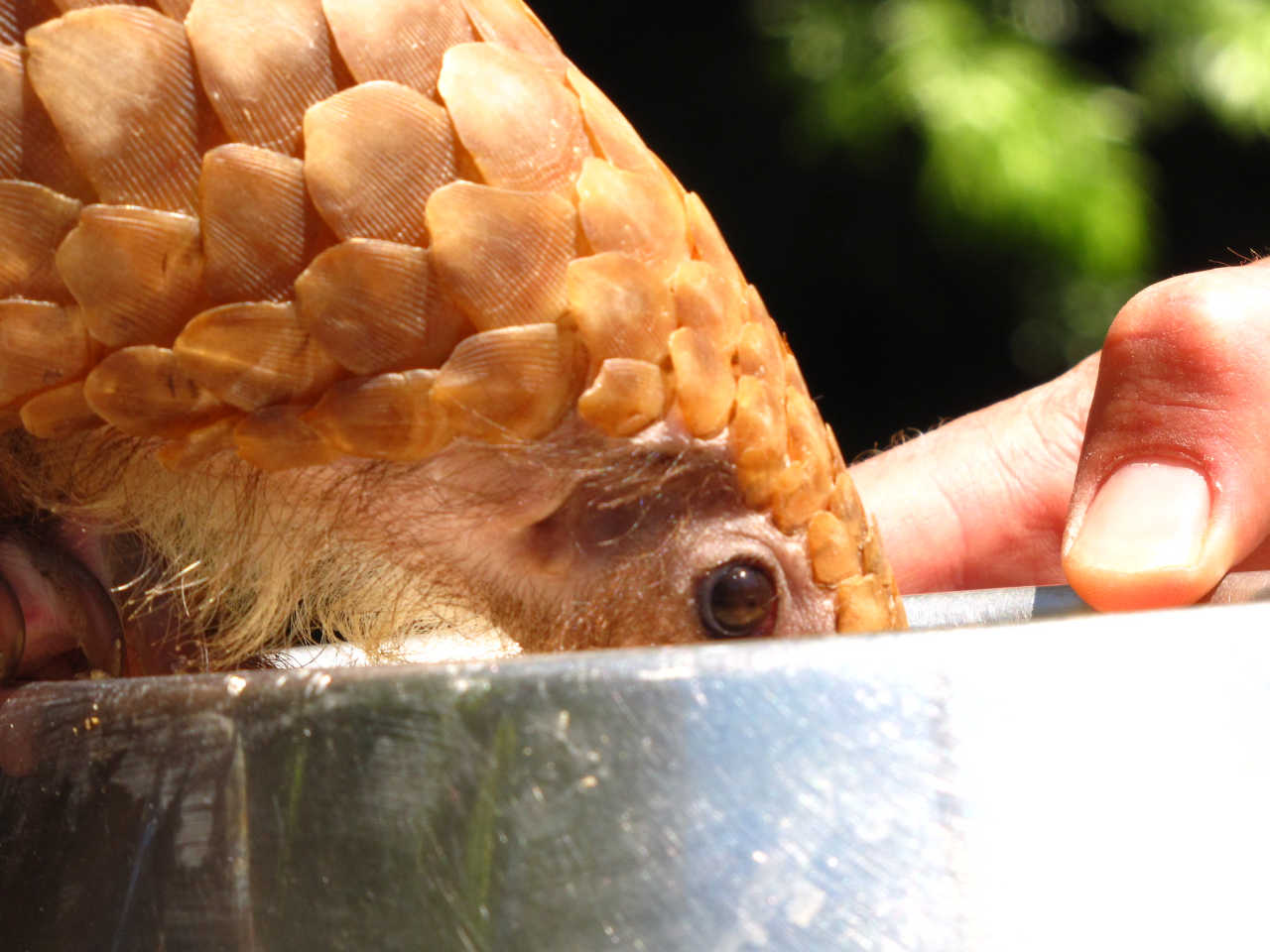
Pangolins are insectivorous. Most of their diet consists of various species of ants and termites and may be supplemented by other insects, especially larvae. They are somewhat particular and tend to consume only one or two species of insects, even when many species are available. A pangolin can consume 140 to 200 g (5 to 7 oz) of insects per day. Pangolins are an important regulator of termite populations in their natural habitats.
Pangolins have very poor vision. They also lack teeth. They rely heavily on smell and hearing, and they have other physical characteristics to help them eat ants and termites. Their skeletal structure is sturdy and they have strong front legs used for tearing into termite mounds. They use their powerful front claws to dig into trees, soil, and vegetation to find prey, then proceed to use their long tongues to probe inside the insect tunnels and to retrieve their prey.
The structure of their tongue and stomach is key to aiding pangolins in obtaining and digesting insects. Their saliva is sticky, causing ants and termites to stick to their long tongues when they are hunting through insect tunnels. Without teeth, pangolins cannot also chew; but while foraging, they ingest small stones (gastroliths), which accumulate in their stomachs to help to grind up ants. This part of their stomach is called the gizzard, and it is also covered in keratinous spines. These spines further aid in the grinding up and digestion of the pangolin's prey.
Some species, such as the tree pangolin, use their strong, prehensile tails to hang from tree branches and strip away bark from the trunk, exposing insect nests inside.

Pangolins are solitary and meet only to have sex, with mating typically taking place at night after the male and female pangolin meet near a watering hole. Males are larger than females, weighing up to 40% more. While the mating season is not defined, they typically mate once each year, usually during the summer or autumn. Rather than the males seeking out the females, males mark their location with urine or feces and the females find them. If competition over a female occurs, the males use their tails as clubs to fight for the opportunity to mate with her.
Gestation periods differ by species, ranging from roughly 70 to 140 days. African pangolin females usually give birth to a single offspring at a time, but the Asiatic species may give birth to from one to three. Weight at birth is 80 to 450 g, and the average length is 150 mm. At the time of birth, the scales are soft and white. After several days, they harden and darken to resemble those of an adult pangolin. During the vulnerable stage, the mother stays with her offspring in the burrow, nursing it, and wraps her body around it if she senses danger. The young cling to the mother's tail as she moves about, although, in burrowing species, they remain in the burrow for the first two to four weeks of life. At one month, they first leave the burrow riding on the mother's back. Weaning takes place around three months of age, when the young begin to eat insects in addition to nursing. At two years of age, the offspring are sexually mature and are abandoned by the mother.
Wikipedia contributors. (2025, February 24). Pangolin. In Wikipedia, The Free Encyclopedia. Retrieved 21:51, March 3, 2025, from https://en.wikipedia.org/w/index.php?title=Pangolin&oldid=1277388601