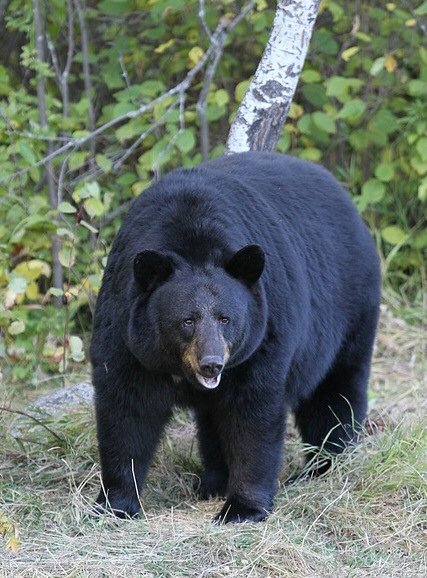
Throughout their range, habitats preferred by American black bears have a few shared characteristics. They are often found in areas with relatively inaccessible terrain, thick understory vegetation and large quantities of edible material (especially masts). The adaptation to woodlands and thick vegetation in this species may have originally been because the bear evolved alongside larger, more aggressive bear species, such as the extinct giant short-faced bear and the grizzly bear, that monopolized more open habitats[41] and the historic presence of larger predators, such as Smilodon and the American lion, that could have preyed on black bears. Although found in the largest numbers in wild, undisturbed areas and rural regions, American black bears can adapt to surviving in some numbers in peri-urban regions, as long as they contain easily accessible foods and some vegetative coverage.[5][page needed]

American black bears are highly dexterous, being capable of opening screw-top jars and manipulating door latches.[43] They also have great physical strength; a bear weighing 120 pounds (54 kg) was observed turning flat rocks weighing 310 to 325 pounds (141 to 147 kg) by flipping them over with a single foreleg.[47] They move in a rhythmic, sure-footed way and can run at speeds of 25 to 30 miles per hour (40 to 48 km/h).[48] American black bears have good eyesight and have been proven experimentally to be able to learn visual color discrimination tasks faster than chimpanzees and just as fast as domestic dogs. They are also capable of rapidly learning to distinguish different shapes such as small triangles, circles and squares.[49]
The American Black bear reside in both Alaska and Canada. In areas where human development is relatively low, such as stretches of Canada and Alaska, American black bears tend to be found more regularly in lowland regions.[41] In parts of northeastern Canada, especially Labrador, American black bears have adapted exclusively to semi-open areas that are more typical habitat in North America for brown bears (likely due to the absence there of brown and polar bears, as well as other large carnivore species).
American Black Bears have started to come back not only to Arkansa but Missouri as well
Bears may communicate with various vocal and non-vocal sounds. Tongue-clicking and grunting are the most common sounds and are made in cordial situations to conspecifics, offspring and occasionally humans. When at ease, they produce a loud rumbling hum. During times of fear or nervousness, bears may moan, huff or blow air. Warning sounds include jaw-clicking and lip-popping. In aggressive interactions, black bears produce guttural pulsing calls that may sound like growling. Cubs squeal, bawl or scream when anxious and make a motor-like humming sound when comfortable or nursing.[71][72][73] American black bears often mark trees using their teeth and claws as a form of communication with other bears, a behavior common to many species of bears.[1]
For more information, check out the link to an absolute URL going to the Wikipedia website.