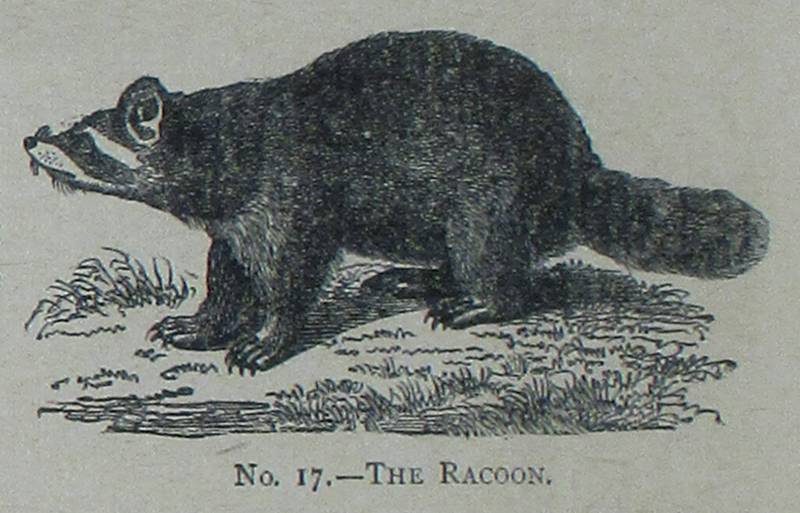
The raccoon (/rəˈkuːn/ or US: /ræˈkuːn/,
Procyon lotor), also spelled racoon[3] and sometimes called the common raccoon or
northern raccoon to distinguish it from the other species, is a mammal native to
North America. It is the largest of the procyonid family, having a body length of
40 to 70 cm (16 to 28 in), and a body weight of 5 to 26 kg (11 to 57 lb). Its
grayish coat mostly consists of dense underfur, which insulates it against cold
weather. The animal's most distinctive features include its extremely dexterous
front paws, its facial mask, and its ringed tail, which are common themes in the
mythologies of the Indigenous peoples of the Americas surrounding the species.
The raccoon is noted for its intelligence, and studies show that it is able to
remember the solution to tasks for at least three years. It is usually nocturnal
and omnivorous, eating about 40% invertebrates, 33% plants, and 27% vertebrates.

In Europe, the raccoon has been included on the list of Invasive Alien Species of
Union Concern since 2016. This implies that this species cannot be imported,
bred, transported, commercialized, or intentionally released into the environment
in the whole of the European Union.
Though previously thought to be generally solitary, there is now evidence that
raccoons engage in sex-specific social behavior. Related females often share a
common area, while unrelated males live together in groups of up to four raccoons
in order to maintain their positions against foreign males during the mating season
and against other potential invaders. Home range sizes vary anywhere from 3 ha
(7.4 acres) for females in cities, to 5,000 ha (12,000 acres) for males in prairies.
After a gestation period of about 65 days, two to five young known as "kits" are
born in spring. The kits are subsequently raised by their mother until dispersal
in late fall. Although captive raccoons have been known to live over 20 years,
their life expectancy in the wild is only 1.8 to 3.1 years. In many areas, hunting
and vehicular injury are the two most common causes of death.
Head to hindquarters, raccoons measure between 40 and 70 cm (16 and 28 in), not including
the bushy tail which can measure between 20 and 40 cm (7.9 and 15.7 in), but is usually
not much longer than 25 cm (9.8 in). The shoulder height is between 23 and
30 cm (9.1 and 11.8 in). The body weight of an adult raccoon varies considerably
with habitat, making the raccoon one of the most variably sized mammals. It can range
from 2 to 26 kg (4.4 to 57.3 lb), but is usually between 5 and 12 kg (11 and 26 lb).
The smallest specimens live in southern Florida, while those near the northern limits
of the raccoon's range tend to be the largest (see Bergmann's rule). Males are
usually 15 to 20% heavier than females. At the beginning of winter, a raccoon
can weigh twice as much as in spring because of fat storage. The largest
recorded wild raccoon weighed 28.4 kg (63 lb) and measured 140 cm (55 in) in total
length, by far the largest size recorded for a procyonid.
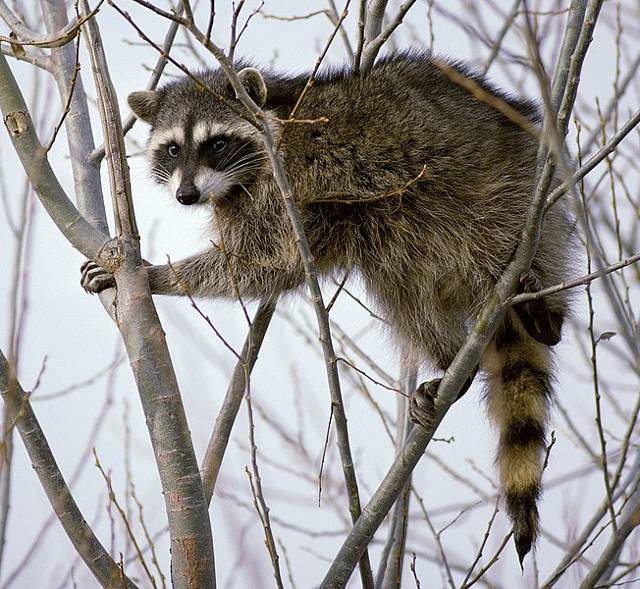
The most characteristic physical feature of the raccoon is the area of black fur around
the eyes, which contrasts sharply with the surrounding white face coloring. This
is reminiscent of a "bandit's mask" and has thus enhanced the animal's reputation
for mischief. The slightly rounded ears are also bordered by white fur. Raccoons
are assumed to recognize the facial expression and posture of other members of
their species more quickly because of the conspicuous facial coloration and the
alternating light and dark rings on the tail.The dark mask may also reduce glare
and thus enhance night vision. On other parts of the body, the long and stiff
guard hairs, which shed moisture, are usually colored in shades of gray and, to a
lesser extent, brown. Raccoons with a very dark coat are more common in the
German population because individuals with such coloring were among those initially
released to the wild. The dense underfur, which accounts for almost 90% of the coat,
insulates against cold weather and is composed of 2 to 3 cm (0.79 to 1.18 in) long hairs.
The raccoon, whose method of locomotion is usually considered to be plantigrade,
can stand on its hind legs to examine objects with its front paws. As raccoons have
short legs compared to their compact torso, they are usually not able either to run
quickly or jump great distances. Their top speed over short distances is 16 to 24
km/h (9.9 to 14.9 mph). Raccoons can swim with an average speed of about 5 km/h
(3.1 mph) and can stay in the water for several hours. For climbing down a tree
headfirst—an unusual ability for a mammal of its size—a raccoon rotates its hind
feet so they are pointing backwards. Raccoons have a dual cooling system to
regulate their temperature; that is, they are able to both sweat and pant for heat dissipation.
Raccoon skulls have a short and wide facial region and a voluminous braincase.
The facial length of the skull is less than the cranial, and their nasal bones
are short and quite broad. The auditory bullae are inflated in form, and the
sagittal crest is weakly developed. The dentition—40 teeth with the dental formula
is adapted to their omnivorous diet: the carnassials are not as sharp and pointed
as those of a full-time carnivore, but the molars are not as wide as those of
a herbivore. The penis bone of males is about 10 cm (3.9 in) long and strongly
bent at the front end, and its shape can be used to distinguish juvenile males
from mature males. Seven of the thirteen identified vocal calls are used in
communication between the mother and her kits, one of these being the birdlike
twittering of newborns.
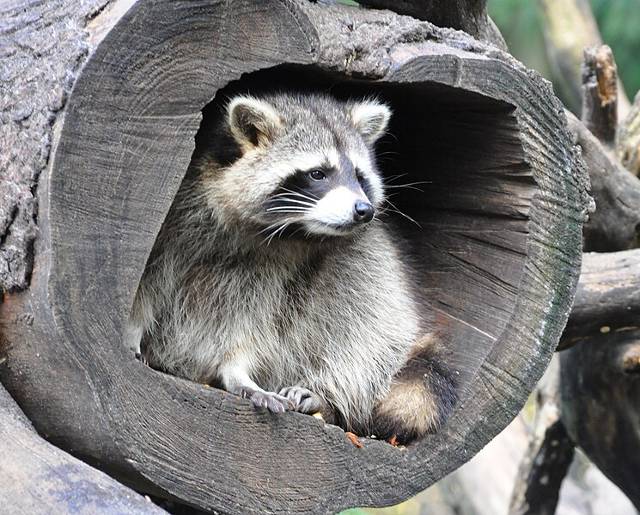
The original habitats of the raccoon are deciduous and
mixed forests, but due to their adaptability, they have extended their range to
mountainous areas, coastal marshes, and urban areas, where some homeowners consider
them to be pests. As a result of escapes and deliberate introductions in the mid-20th century, raccoons
are now also distributed across central Europe, the Caucasus, and Japan.

