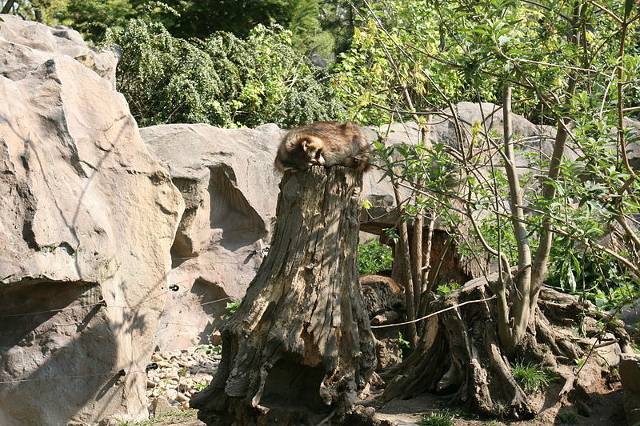
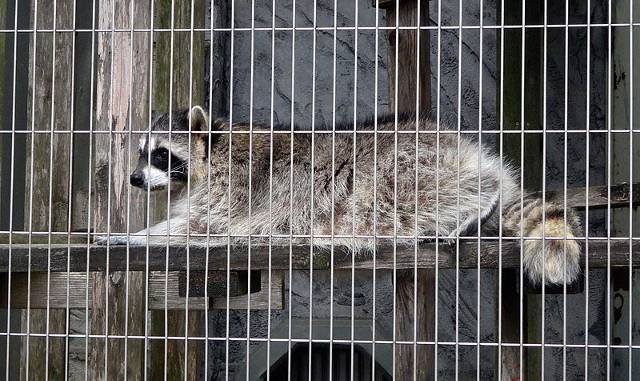
Although they have thrived in sparsely wooded areas in the last decades,
raccoons depend on vertical structures to climb when they feel threatened.
Therefore, they avoid open terrain and areas with high concentrations of
beech trees, as beech bark is too smooth to climb. Tree hollows in old
oaks or other trees and rock crevices are preferred by raccoons as sleeping,
winter and litter dens. If such dens are unavailable or accessing them is
inconvenient, raccoons use burrows dug by other mammals, dense undergrowth
or tree crotches. In a study in the Solling range of hills in Germany,
more than 60% of all sleeping places were used only once, but those used at
least ten times accounted for about 70% of all uses. Since amphibians,
crustaceans, and other animals around the shore of lakes and rivers are an
important part of the raccoon's diet, lowland deciduous or mixed forests
abundant with water and marshes sustain the highest population densities.
While population densities range from 0.5 to 3.2 animals per square
kilometer (1.3 to 8.3 animals per square mile) in prairies and do not
usually exceed 6 animals per square kilometer (15.5 animals per square
mile) in upland hardwood forests, more than 20 raccoons per square
kilometer (51.8 animals per square mile) can live in lowland forests
and marshes
Raccoons are common throughout North America from Canada to Panama, where
the subspecies Procyon lotor pumilus coexists with the crab-eating raccoon
(Procyon cancrivorus). The population on Hispaniola was exterminated as early
as 1513 by Spanish colonists who hunted them for their meat. Raccoons were
also exterminated in Cuba and Jamaica, where the last sightings were reported
in 1687. The Barbados raccoon became extinct relatively recently, in 1964.
When they were still considered separate species, the Bahamas raccoon,
Guadeloupe raccoon and Tres Marias raccoon were classified as endangered by
the IUCN in 1996.
There is archeological evidence that in pre-Columbian times raccoons were
numerous only along rivers and in the woodlands of the Southeastern United
States. As raccoons were not mentioned in earlier reports of pioneers
exploring the central and north-central parts of the United States,
their initial spread may have begun a few decades before the 20th century.
Since the 1950s, raccoons have expanded their range from Vancouver Island—
formerly the northernmost limit of their range—far into the northern portions
of the four south-central Canadian provinces. New habitats which have recently
been occupied by raccoons (aside from urban areas) include mountain ranges,
such as the Western Rocky Mountains, prairies and coastal marshes. After a
population explosion starting in the 1940s, the estimated number of raccoons
in North America in the late 1980s was 15 to 20 times higher than in the
1930s, when raccoons were comparatively rare. Urbanization, the expansion
of agriculture, deliberate introductions, and the extermination of natural
predators of the raccoon have probably caused this increase in abundance
and distribution.
Distribution outside North America
As a result of escapes and deliberate introductions in the mid-20th century, the raccoon is now
distributed in several European and Asian countries. Sightings have occurred in all the countries
bordering Germany, which hosts the largest population outside of North America. Another stable
population exists in northern France, where several pet raccoons were released by members of the
U.S. Air Force near the Laon-Couvron Air Base in 1966. Furthermore, raccoons have been known to
be in the area around Madrid since the early 1970s. In 2013, the city authorized "the capture
and death of any specimen". It is also present in Italy, with one self-sustaining population in Lombardy.
About 1,240 animals were released in nine regions of the former Soviet Union between 1936 and 1958
for the purpose of establishing a population to be hunted for their fur. Two of these introductions
were successful – one in the south of Belarus between 1954 and 1958, and another in Azerbaijan
between 1941 and 1957. With a seasonal harvest of between 1,000~1,500 animals, in 1974 the
estimated size of the population distributed in the Caucasus region was around 20,000 animals
and the density was four animals per square kilometer (10 animals per square mile).
In Germany – where the raccoon is called the Waschbär (literally, 'wash-bear' or 'washing bear')
due to its habit of "dousing" food in water – two pairs of pet raccoons were released into the
German countryside at the Edersee reservoir in the north of Hesse in April 1934 by a forester
upon request of their owner, a poultry farmer. He released them two weeks before receiving
permission from the Prussian hunting office to "enrich the fauna". Several prior attempts to
introduce raccoons in Germany had been unsuccessful. A second population was established
in eastern Germany in 1945 when 25 raccoons escaped from a fur farm at Wolfshagen (today
district of Altlandsberg), east of Berlin, after an air strike. The two populations are
parasitologically distinguishable: 70% of the raccoons of the Hessian population are
infected with the roundworm Baylisascaris procyonis, but none of the Brandenburgian
population is known to have the parasite. In the Hessian region, there were an estimated
285 raccoons in 1956, which increased to over 20,000 in 1970; in 2008 there were between
200,000 and 400,000 raccoons in the whole of Germany. By 2012 it was estimated that
Germany now had more than a million raccoons.
The raccoon was once a protected species in Germany, but has been declared a game animal
in 14 of the 16 German states since 1954. Hunters and environmentalists argue the raccoon
spreads uncontrollably, threatens protected bird species, and supersedes indigenous competitors.
This view is opposed by the zoologist Frank-Uwe Michler, who finds no evidence that a high
population density of raccoons leads to negative effects on the biodiversity of an area.
Hohmann holds that extensive hunting cannot be justified by the absence of natural predators,
because predation is not a significant cause of death in the North American raccoon population.
The raccoon is extensively hunted in Germany as it is seen as an invasive species and pest.
In the 1990s, only about 400 raccoons were hunted yearly. This increased dramatically over the
next quarter-century: during the 2015–2016 hunting season, 128,100 raccoons were hunted, 60
percent of them in the state of Hesse.
In Japan, up to 1,500 raccoons were imported as pets each year after the success of the anime
series Rascal the Raccoon (1977). In 2004, the descendants of discarded or escaped animals lived
in 42 of 47 prefectures. The range of raccoons in the wild in Japan grew from 17 prefectures in
2000 to all 47 prefectures in 2008. It is estimated that raccoons cause thirty million yen
(~$275,000) of agricultural damage on Hokkaido alone.
Distribution in the former Soviet Union
Experiments in acclimatising raccoons into the Soviet Union began in 1936, and were repeated
a further 25 times until 1962. Overall, 1,222 individuals were released, 64 of which came from
zoos and fur farms (38 of them having been imports from western Europe). The remainder
originated from a population previously established in Transcaucasia. The range of Soviet
raccoons was never single or continuous, as they were often introduced to different locations
far from each other. All introductions into the Russian Far East failed; melanistic raccoons
were released on Petrov Island near Vladivostok and some areas of southern Primorsky Krai,
but died. In Central Asia, raccoons were released in Kyrgyzstan's Jalal-Abad Province, though
they were later recorded as "practically absent" there in January 1963. A large and stable raccoon
population (yielding 1,000~1,500 catches a year) was established in Azerbaijan after an introduction
to the area in 1937. Raccoons apparently survived an introduction near Terek, along the Sulak River
into the Dagestani lowlands. Attempts to settle raccoons on the Kuban River's left tributary and
Kabardino-Balkaria were unsuccessful. A successful acclimatization occurred in Belarus, where three
introductions (consisting of 52, 37, and 38 individuals in 1954 and 1958) took place. By January 1963,
700 individuals were recorded in the country.