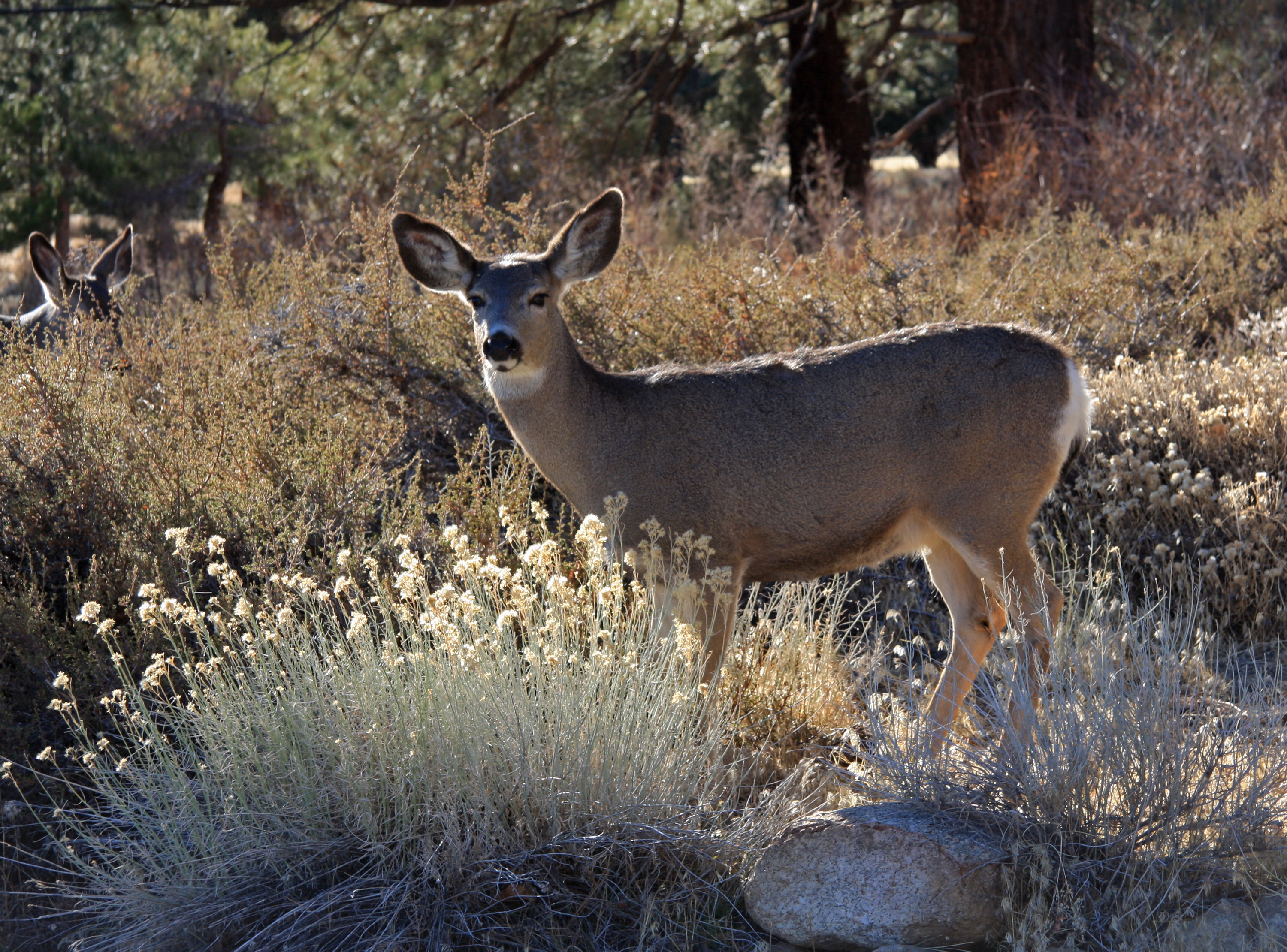
Unlike the related white-tailed deer (Odocoileus virginianus), which is found throughout most of North America east of the Rocky Mountains and in the valleys of the Rocky Mountains from Idaho and Wyoming northward, mule deer are found only on the western Great Plains, in the Rocky Mountains, in the southwest United States, and on the west coast of North America. Mule deer have also been introduced to Argentina and Kauai, Hawaii.[5]
Mule deer (sensu stricto) group:
O. h. californicus – California mule deer. This widespread subspecies is found throughout much of California.
It is notably absent from the Central Valley and the agricultural districts of the state.
It is also known to range across the border into west-central Nevada, between Reno and Carson City.[14]
O. h. cerrosensis – Cedros or Cerros Island mule deer, after Cedros Island, off of the southwestern
Pacific coast of Baja California state, the subspecies' sole habitat.[15] O. h. eremicus – Desert or burro mule deer.
Primarily found in the Lower Colorado River Valley, Southern California's Inland Empire, the areas around Las Vegas
and extreme southern Nevada, much of Arizona and parts of southern New Mexico.[16]O. h. fuliginatus –
Southern mule deer. Mainly found in Southern California (Los Angeles, Orange and San Diego Counties)
and along the U.S.-Mexico borderlands, into the northern half of the Baja California Peninsula.
O. h. hemionus – Rocky Mountain mule deer. Primarily found in western and central North America, as far
south as Colorado and as far north as Yukon and the Northwest Territories.
O. h. inyoensis – Inyo mule deer (named after Inyo County, California). This deer is primarily found
within the Sierra Nevadas and Yosemite, within inland Central California. O. h. peninsulae –
Baja or Peninsular mule deer; found across the majority of the state of Baja California Sur, Mexico.[21]
O. h. sheldoni – Tiburón Island mule deer, also called the venado bura de Tiburón in Spanish.
This deer is only found on Tiburón Island, Mexico, in the Gulf of California.[22]
Black-tailed deer group:
O. h. columbianus – Columbian black-tailed deer; found primarily in coastal temperate rainforest
habitats of the Pacific Northwest and Northern California. O. h. sitkensis – Sitka black-tailed deer
(named after Sitka, Alaska); found in similar temperate rainforests as the Columbian subspecies—though
with a more northerly range—from the central coast of British Columbia (including Haida Gwaii) throughout
Southeast Alaska (along the Gulf of Alaska).
For more information, please check out the link to an absolute URL going to the Wikipedia website