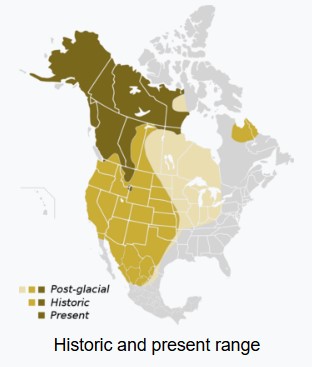
Grizzly bears can be found in woodlands, forests, alpine meadows, and prairies. In many habitats they prefer riparian areas along rivers and streams. In North America, grizzly bears previously roamed throughout the entire United States from Alaska south into Mexico, from California to the western shores of the Hudson Bay. Control actions and habitat loss extirpated them from 98 percent of their original habitat in the U.S., including the Great Plains and all habitats south of Yellowstone National Park and Grand Teton National Park in Wyoming. This also included most of California, Oregon, Washington and Idaho. Populations persisted in the Northern Rocky Mountains including in Yellowstone and Glacier National Parks and in northwestern Montana and extreme northern Idaho next to Canada. A large population of grizzly bears lives inland in Alaska and northern Canada. Thanks to conservation efforts since about 1975, grizzly bears are recovering well in Yellowstone and elsewhere in the Northern Rockies and are even beginning to recolonize prairie habitats along the Rocky Mountain Front in Montana. There have also been discussions recently about reintroducing grizzly bears back into remote parts of states such as California.
In Canada, there are approximately 25,000 grizzly bears occupying British Columbia, Alberta, the Yukon, the Northwest Territories, Nunavut, and the northern part of Manitoba. An article published in 1954 suggested they may be present in the tundra areas of the Ungava Peninsula and the northern tip of Labrador-Quebec. In British Columbia, grizzly bears inhabit approximately 90% of their original territory. There were approximately 25,000 grizzly bears in British Columbia when the European settlers arrived. However, population size has since significantly decreased due to hunting and habitat loss. In 2008, it was estimated there were 16,000 grizzly bears. A revised Grizzly bear count in 2012 for British Columbia was 15,075. Population estimates for British Columbia are based on hair-snagging, DNA-based inventories, mark-and-recapture, and a refined multiple regression model. In 2003, researchers from the University of Alberta spotted a grizzly on Melville Island in the high Arctic, which is the most northerly sighting ever documented.