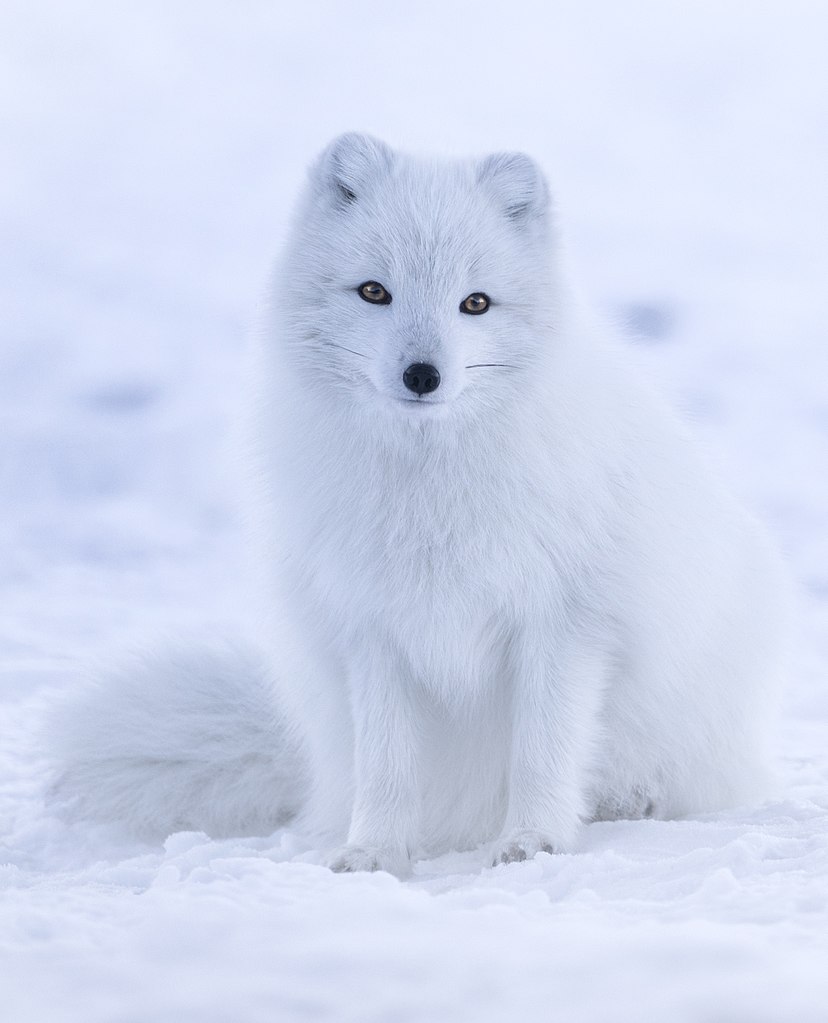
The Arctic fox (Vulpes lagopus), also known as the White Fox, polar fox, or snow fox, is a small fox native to the Arctic regions of the Northern Hemisphere and common throughout the Arctic tundra biome.[1][7][8] It is well adapted to living in cold environments, and is best known for its thick, warm fur that is also used as camouflage. It has a large and very fluffy tail. In the wild, most individuals do not live past their first year but some exceptional ones survive up to 11 years.[9] Its body length ranges from 46 to 68 cm (18 to 27 in), with a generally rounded body shape to minimize the escape of body heat.
Arctic foxes have beautiful white (sometimes blue-gray) coats that act as very effective winter camouflage. The natural hues allow the animal to blend into the tundra's ubiquitous snow and ice. When the seasons change, the fox's coat turns as well, adopting a brown or gray appearance that provides cover among the summer tundra's rocks and plants.
The Arctic fox preys on many small creatures such as lemmings, voles, ringed seal pups, fish, waterfowl, and seabirds. It also eats carrion, berries, seaweed, and insects and other small invertebrates. Arctic foxes form monogamous pairs during the breeding season and they stay together to raise their young in complex underground dens. Occasionally, other family members may assist in raising their young. Natural predators of the Arctic fox are golden eagles,[10] Arctic wolves, polar bears,[11] wolverines, red foxes, and grizzly bears.[12][13] My example links to Iceland. Lorem ipsum dolor sit amet, consetetur sadipscing elitr, sed diam nonumy eirmod tempor invidunt ut labore et dolore magna aliquyam erat, sed diam voluptua. At vero eos et accusam et justo duo dolores et ea rebum. Stet clita kasd gubergren, no sea takimata sanctus est Lorem ipsum dolor sit amet. Go to the top of the page
For more information, check out the link to an absolute URL going to the Wikipedia website.