| Meditteranean |
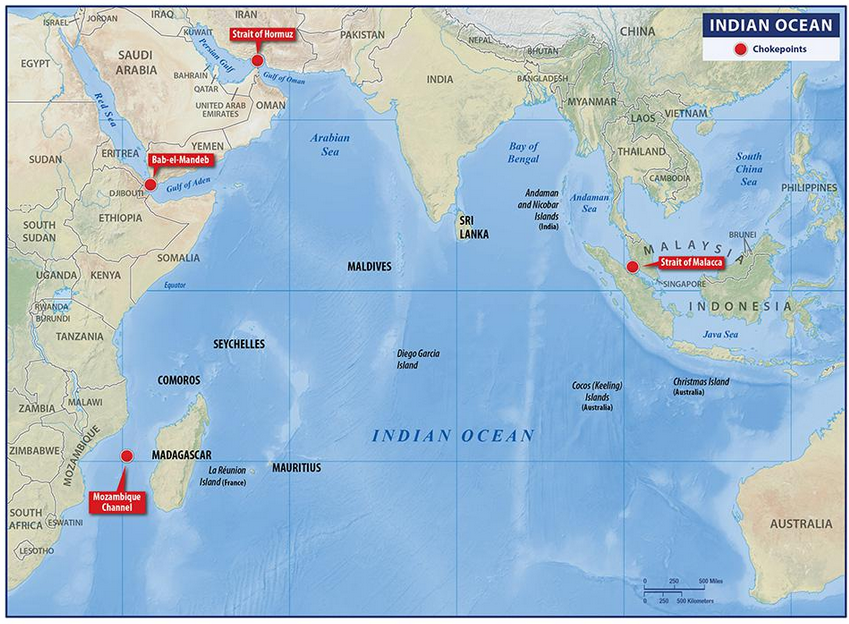
Indian Ocean |
South/East Asia |
| Begins at Straights of Gibraltar, connected to Indian ocean
through the Red Sea and Suez canal. |
Encompasses maritime Arabia, East Africa (through the Red Sea) and the Indian subcontinent which
has functioned as a bridge point for ideas and resources for millenia,
currently the avenues by which persian gulf oil is shipped between the Persian
Gulf in Europe. |
The Asian networks and Maritime chokepoints that econpass
the south east Asian trading networks. This region includes the
straights of Malacca, island south East Asia in the South and
Japan, Korea and eastern china and Taiwan in the north |
| Home to ancient civilizations like Egypt, Israel, the Phonenicians,
Greeks, Etruscans and Romans. Intersects with three continents, Europe, Asia, Africa.
Only overland connections to the Indian Ocean until completion of the Suez Canal in 1869.
Though there is some evidence of canals linking the Red to the Nile in antiquity |
Home to many ancients civilizations, heavily connected to the Mesopotamian cradle of
civilization and Indus Valley. Later Buddhism and later Islam spread to India and Southeast
Asia along these routes. India's unique geography gives it unique influence along this route
and its connection to other places. |
Seperated from the Indian Ocean by the Straights of Malacca. Influenced (keyword) by the
civilization interplay of China, India, Islamic and Japanese civilizations each adapting
to well developed indigenous societies. |
| Meets the northern European plane across the Alps and North through France.
Meditteranean Europe and Northern Europe are divided by Germanic vs romance languages and
relgion, protestant/catholic. African regions are generally Islamic with the Middle Eastern
are also heavily Arabic speaking Muslim. Instability of Islamic states in the region, migration,
increases tensions. |
Massive variety of people currently live in the area. India is a rising power which will
increasingly control traffic and potential increase influence in Islamic (but navally deficient)
Persian Gulf states. |
Engine of conflict today as China aims to domininate this region to secure traffic into the Indian
ocean. This region saw the first truly global trading between China and the West in the Philippines as Spanish
Silver was traded for Chinese goods. Now the same routes are competed over by the USA and a newly outward
looking China. |