Locomotion
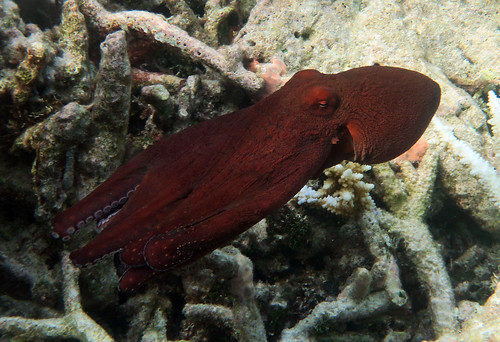
Day Octopus
By
Doug Finney/
CC BY-NC 2.0
Octopuses move mainly by crawling slowly and swimming in a head-first position.
The faster way of moving for an octopus is backward swimming, also known as jet propulsion.
When crawling along the ocean floor, an octopus will extend its arms forward,
adhere its suckers to the rocky surface, and propel itself forward.
Lifespan
Octopuses have short lifespans, with some species' lifespans completed in only six months.
The lifespan of an octopus is limited by its reproductive cycle, with the exception of
the larger Pacific striped octopus,
which can reproduce numerous times over its two-year lifespan.
In the last stage of an octopus's life, an octopus forms lesions,
quickly weakens, does not feed
and is unable to defend themselves leaving them vunerable.
This last stage is called Senescence,
it is the the breakdown of cellular function without repair or replacement.
The Senescence timeline for Female and Male Octopus differs:
- In Female Octopus, Senescence begins after laying eggs.
- In Male Octopus, Senescence begins after mating.
Intelligence
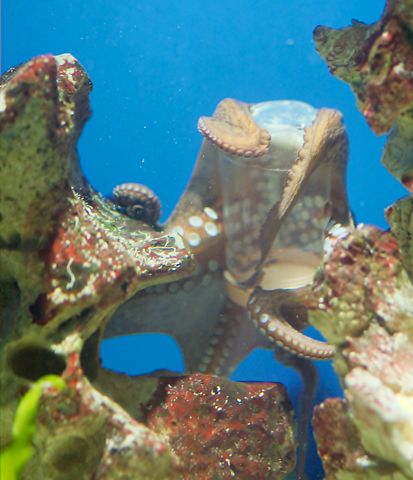
Oktopus opening a container with screw cap
By
Matthias Kabel /
CC BY 2.5
.jpg)
Octopuses demonstrate high intelligence and, through various experiments including maze and
problem-solving,
show evidence that they're capable of storing short and long-term information.
Octopuses have also been observed
to engage in behavior that may indicate sentience, such as:
- Escaping enclosure: in search of food octopuses may break out of aquariums
- Play: catching and releasing toys or other obects in their aquarium
- Tool Use: collecting coconut shells to create shelter