Home - Giant Anteater
Taken from Wikipedia
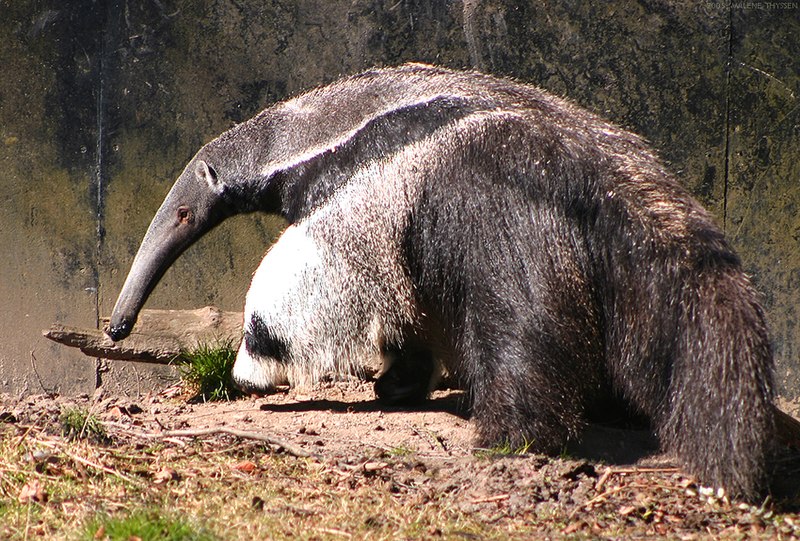
Malene Thyssen, CC BY-SA 3.0, via Wikimedia Commons

Scientific classification
- Domain: Eukaryota
- Kingdom: Animalia
- Phylum: Chordata
- Class: Mammalia
- Order: Pilosa
- Family: Myrmecophagidae
- Genus: Myrmecophaga
- Linnaeus, 1758[4]
- Species: M. tridactyla
The giant anteater (Myrmecophaga tridactyla) is an insectivorous mammal native to Central and South America. It is one of four living species of anteaters, of which it is the largest member. The only extant member of the genus Myrmecophaga, it is classified with sloths in the order Pilosa. This species is mostly terrestrial, in contrast to other living anteaters and sloths, which are arboreal or semiarboreal. The giant anteater is 182 to 217 cm (72 to 85 in) in length, with weights of 33 to 50 kg (73 to 110 lb) for males and 27 to 47 kg (60 to 104 lb) for females. It is recognizable by its elongated snout, bushy tail, long fore claws, and distinctively colored pelage.
The giant anteater is found in multiple habitats, including grassland and rainforest. It forages in open areas and rests in more forested habitats. It feeds primarily on ants and termites, using its fore claws to dig them up and its long, sticky tongue to collect them. Though giant anteaters live in overlapping home ranges, they are mostly solitary except during mother-offspring relationships, aggressive interactions between males, and when mating. Mother anteaters carry their offspring on their backs until weaning them.
Taxonomy
The giant anteater got its binomial name from Carl Linnaeus in 1758. Its generic name, Myrmecophaga, and specific name, tridactyla, are both Greek, meaning "anteater" and "three fingers", respectively.[6] Myrmecophaga jubata was used as a synonym. Three subspecies have been suggested: M. t. tridactyla (Venezuela and the Guianas south to northern Argentina), M. t. centralis (Central America to northwestern Colombia and northern Ecuador), and M. t. artata (northeastern Colombia and northwestern Venezuela). The giant anteater is grouped with the semiarboreal northern and southern tamanduas in the family Myrmecophagidae. Together with the family Cyclopedidae, whose only extant member is the arboreal silky anteater, the two families comprise the suborder Vermilingua.[7]
Feeding Anatomy
The giant anteater has no teeth and is capable of very limited jaw movement. It relies on the rotation of the two halves of its lower jaw, held together by a ligament connecting the rami, to open and close its mouth. This is accomplished by its chewing muscles, which are relatively underdeveloped. Jaw depression creates an oral opening large enough for the slender tongue to flick out.[18][27] It has a length of around 60 cm (24 in)[6] and is more triangular in the back but becomes more rounded towards the front and ends in a rounded tip.[18][28] The tongue has backward-curving papillae and is extremely moist due to the large salivary glands.[17]
This site was programmed by Liam