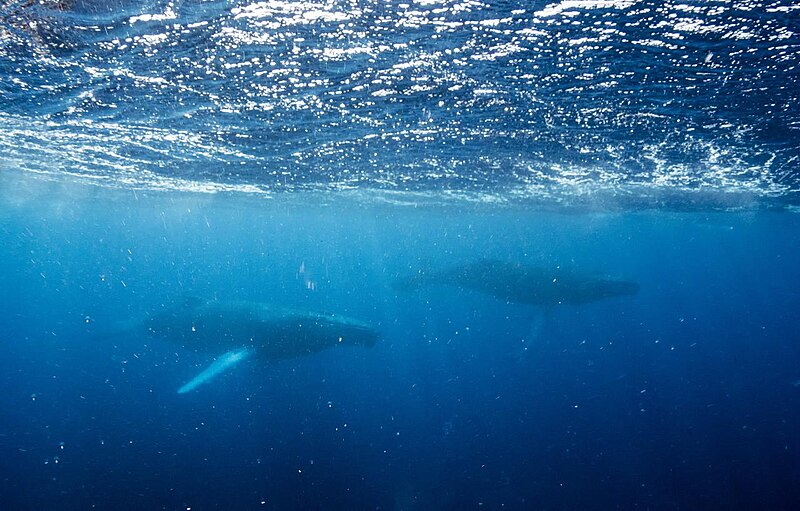
Christopher Michel
CC BY 2.0
Humpback whales are found in marine waters worldwide, except for some
areas at the equator and High Arctic and some enclosed seas. The areas are seperated as
the Northern Hemisphere and the Southern Hemisphere. The
farthest they have been recorded is at 81°N around northern
Franz Josef Land. They are usually coastal and tend to congregate
in waters within continental shelves. Their winter breeding grounds
are located around the equator; their summer feeding areas are found in
colder waters, including near the polar ice caps. Humpbacks go on vast
migrations between their feeding and breeding areas, often crossing the
open ocean. The species has been recorded traveling up to 8,000 km
(5,000 mi) in one direction.
Northern Hemisphere
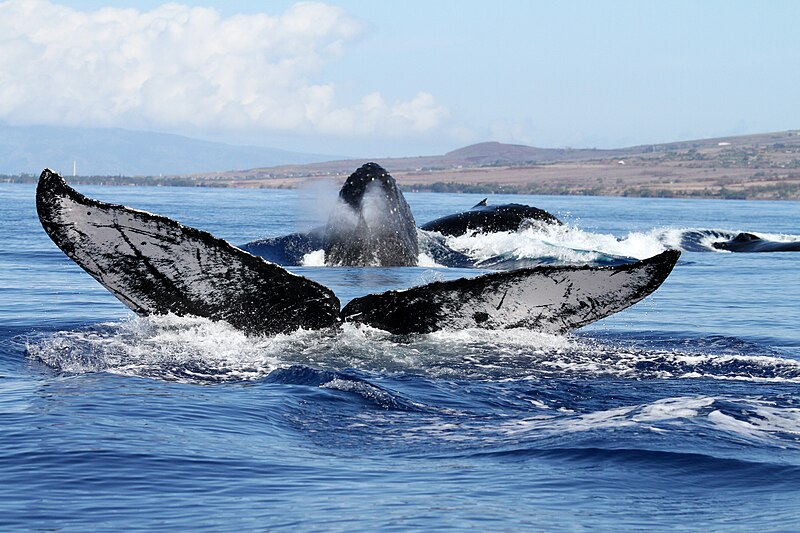 National Marine Sanctuaries
In the North Atlantic, there are two separate wintering populations,
one in the West Indies, from Cuba to northern Venezuela, and the other
in the Cape Verde Islands and northwest Africa. During summer, West
Indies humpbacks congregate off New England, eastern Canada, and western
Greenland, while the Cape Verde population gathers around Iceland and
Norway. There is some overlap in the summer ranges of these populations,
and West Indies humpbacks have been documented feeding farther east.
Whale visits into the Gulf of Mexico have been infrequent but have
occurred in the gulf historically. They were considered to be
uncommon in the Mediterranean Sea, but increased sightings, including
re-sightings, indicate that more whales may colonize or recolonize it in
the future.
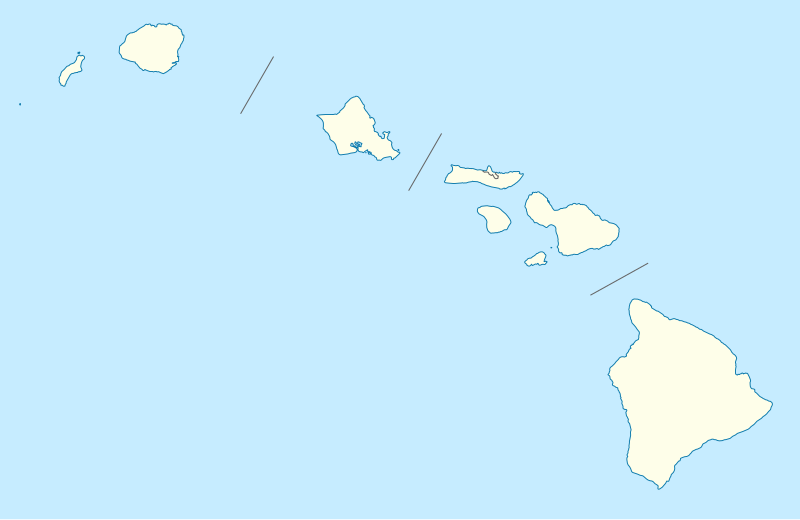 NordNordWest
,
CC BY-SA 3.0 DE
The North Pacific has at least four breeding populations: off Mexico
(including Baja California and the Revillagigedos Islands), Central
America, the Hawaiian Islands, and both Okinawa and the Philippines.
The Mexican population forages from the Aleutian Islands to California.
During the summer, Central American humpbacks are found only off Oregon
and California. In contrast, Hawaiian humpbacks have a wide feeding
range, but most travel to southeast Alaska and northern British
Columbia. The wintering grounds of the Okinawa/Philippines population
are mainly around the Russian Far East. There is some evidence for a
fifth population somewhere in the northwestern Pacific. These whales
are recorded to feed off the Aleutians, with a breeding area somewhere
south of the Bonin Islands.
An isolated, non-migratory population feeds and breeds in the northern
Indian Ocean, mainly in the Arabian Sea around Oman. This population
has also been recorded in the Gulf of Aden, the Persian Gulf, and off
the coasts of Pakistan and India.
Southern Hemisphere
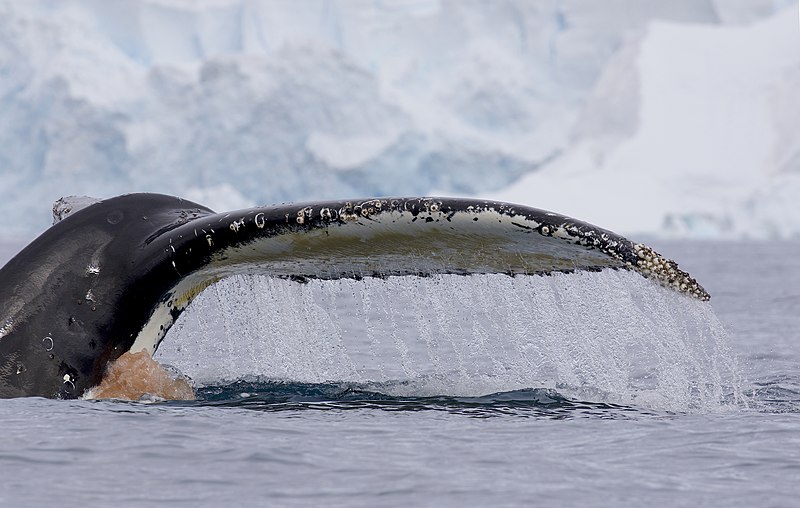 Gregory "Slobirdr" Smith
,
CC BY-SA 2.0
In the Southern Hemisphere, humpback whales are divided into seven
breeding stocks, some of which are further divided into sub-structures.
These include the southwestern Atlantic (stock A), the southeastern
Atlantic (stock B), the southwestern Indian Ocean (stock C), the
southeastern Indian Ocean (stock D), the southwestern Pacific and
Oceania (stocks E and F), and the southeastern Pacific (stock G).
Stock G breeds in tropical and subtropical waters off the west coast of
Central and South America and forages along the west coast of the
Antarctic Peninsula, the South Orkney Islands, and to a lesser extent
Tierra del Fuego. Stock A winters off Brazil and migrates to summer
grounds around South Georgia and the South Sandwich Islands. Some
stock A individuals have also been recorded off the western Antarctic
Peninsula, suggesting an increased blurring of the boundaries between
the feeding areas of stocks A and G.
Stock B breeds on the west coast of Africa and is further divided
into Bl and B2 subpopulations, the former ranging from the Gulf of
Guinea to Angola and the latter ranging from Angola to western South
Africa. Stock B whales have been recorded foraging in waters to the
southwest of the continent, mainly around Bouvet Island. Comparison
of songs between those at Cape Lopez and the Abrolhos Archipelago
indicate that trans-Atlantic mixings between stock A and stock B
whales occur. Stock C whales winter around southeastern Africa
and surrounding waters. This stock is further divided into C1, C2, C3,
and C4 subpopulations; C1 occurs around Mozambique and eastern South
Africa, C2 around the Comoro Islands, C3 off the southern and eastern
coast of Madagascar, and C4 around the Mascarene Islands. The feeding
range of this population is likely between coordinates 5°W and 60°E and
south of 50°S. There may be overlap in the feeding areas of
stocks B and C.
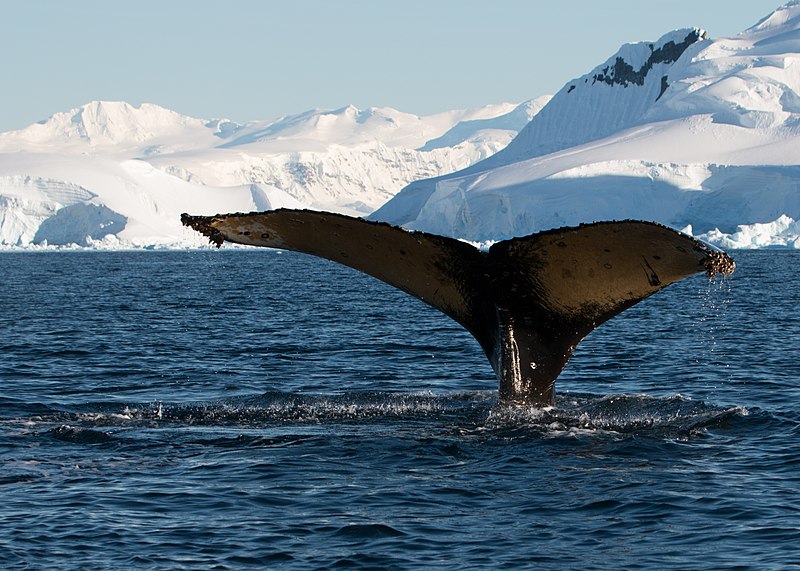
Gary Bembridge from London, UK, CC BY 2.0
Stock D whales breed off the western coast of Australia and forage in
the southern region of the Kerguelen Plateau. Stock E is divided
into E1, E2, and E3 subpopulations. E1 whales have a breeding
range off eastern Australia and Tasmania; their main feeding range is
close to Antarctica, mainly between 130°E and 170°W. The Oceania
stock is divided into the New Caledonia (E2), Tonga (E3), Cook Islands
(F1), and French Polynesia (F2) subpopulations. This stock's feeding
grounds mainly range from around the Ross Sea to the Antarctic Peninsula.
.jpg)

_-_Flickr_-_Gregory_%22Slobirdr%22_Smith.jpg)
.jpg)